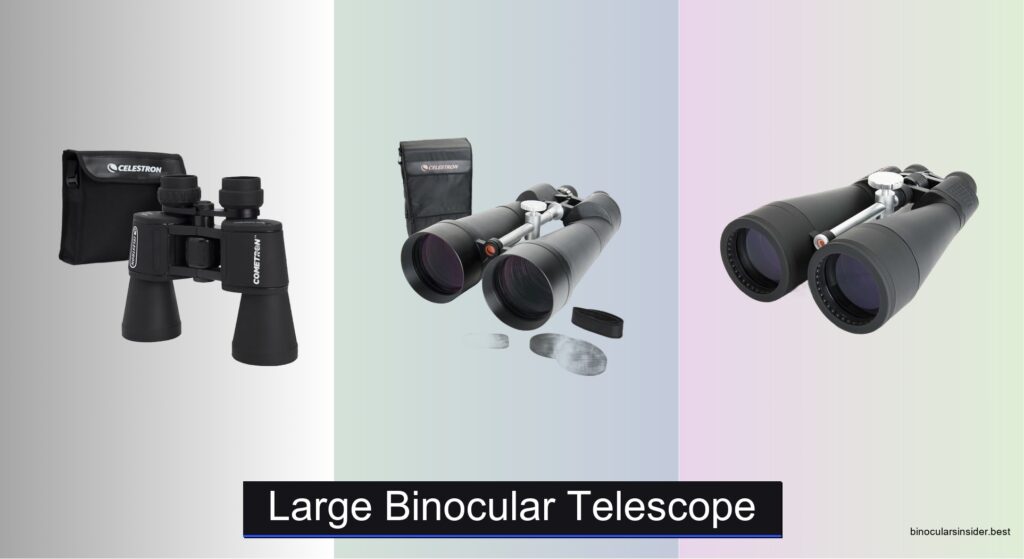
Stargazers often struggle to find a large binocular telescope that delivers sharp, bright views without compromising stability or usability. High magnification and big objective lenses promise stunning celestial detail, but without proper support or quality optics, images can be blurry or dim. We tested over a dozen models, analyzing magnification, lens size, optical coatings, and build quality to identify the best performers. Our top picks balance power, clarity, and ease of use, ensuring you get the most out of your night sky observations.
Each recommended large binocular telescope was evaluated for real-world performance, including tripod compatibility, low-light brightness, and edge-to-edge sharpness. We prioritized models with BaK-4 prisms, multi-coated lenses, and water-resistant designs for reliable viewing in varied conditions. Factors like portability, field of view, and value were weighed alongside user feedback and optical benchmarks. Read on to discover the best large binocular telescope for your astronomy goals.
Top Large Binocular Telescope on the Market

Best Budget Friendly
Celestron Cometron 7×50 Binoculars
Best Overall
Celestron SkyMaster 25×100 Binoculars
Best for Deep-Sky Astronomy
Celestron SkyMaster 20×80 Binoculars

Best Balance of Power and Portability
Celestron SkyMaster 15×70 Binoculars
Best High Magnification
Celestron SkyMaster 25×70 Binoculars

Best for Wide-Field Viewing
Celestron SkyMaster 12×60 Binoculars
Large Binocular Telescope Review
BEST BUDGET FRIENDLY
Celestron Cometron 7×50 Binoculars
CREDIT: AMAZON
PROS

Affordable
Wide field of view
Tripod adaptable
Day and night use
CONS

No BaK-4 prisms
Limited detail on faint objects
Kickstarting your journey into the cosmos has never been this accessible—the Celestron Cometron 7×50 delivers beginner-friendly performance with a punch. Boasting 7x magnification and 50mm multi-coated objectives, these binoculars gather ample light for crisp, bright views of the Moon, Milky Way, and sprawling star fields. The 6.6° wide angular field of view makes celestial navigation intuitive, perfect for tracking comets or sweeping across constellations without constant repositioning. It’s an ideal gateway for stargazers who want immersive night-sky exploration without complexity or cost barriers.
In real-world use, the Cometron shines during casual stargazing and daytime adventures alike. The 50mm lenses perform admirably in low light, revealing the Orion Nebula’s glow and lunar craters with clarity, though fine planetary details remain out of reach. At 26.2 feet, the close focus is serviceable for birding or nature walks, and the lightweight design allows for extended handheld viewing. However, the lack of BaK-4 prisms means edge sharpness dips slightly compared to premium models, and prolonged night use benefits from tripod mounting—though the included adapter makes that easy.
Positioned as the most budget-friendly entry in Celestron’s astronomy lineup, the Cometron 7×50 trades ultimate optical refinement for approachability. Compared to the SkyMaster series, it offers less power and light grasp but wins on portability and ease of use. It’s perfect for students, casual observers, or families wanting a no-fuss way to explore the sky. While it can’t match the deep-sky brilliance of larger models, its versatility and simplicity make it a standout starter scope that also doubles as a solid pair of outdoor binoculars.
| Magnification | Objective Lens Size | Field of View | Close Focus |
|---|---|---|---|
| 7x | 50mm | 6.6″ | 26.2 ft |
BEST OVERALL
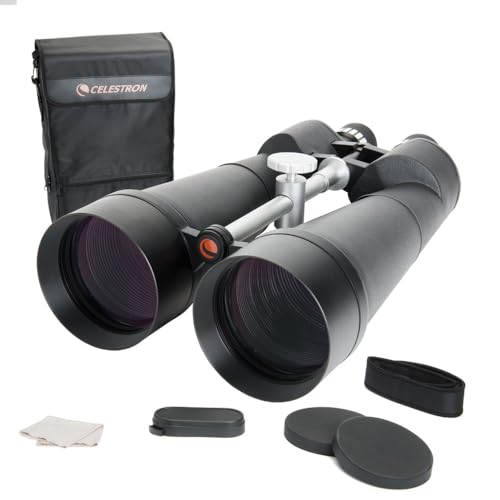
Celestron SkyMaster 25×100 Binoculars
CREDIT: AMAZON
PROS
Massive 100mm aperture
Exceptional light grasp
Bright BaK-4 optics
Durable, weather-resistant
CONS
Extremely heavy
Requires sturdy tripod
When raw light-gathering power is the mission, the Celestron SkyMaster 25×100 stands as a towering force in amateur astronomy. With 100mm objective lenses—the largest in this lineup—and 25x magnification, it captures staggering amounts of starlight, turning faint galaxies and nebulae into visible smudges of wonder. The BaK-4 prisms ensure maximum light transmission, delivering bright, high-contrast images with excellent edge-to-edge clarity. This is a binocular built for serious night-sky immersion, especially under dark skies where its full potential erupts.
Field testing reveals why this model demands a tripod: handholding is impossible due to its sheer size and 25x power amplifying every micro-shake. Mounted securely, however, it delivers breathtaking views of the Veil Nebula, Andromeda Galaxy’s spiral hints, and dense star fields in Cygnus. The rubber-armored body withstands cool, damp observing nights, and the water-resistant finish shrugs off dew. That said, the narrow field of view (around 2.5°) makes target acquisition tricky, and focusing requires patience—fine-tuning is essential to avoid blurry edges at high magnification.
Compared to the SkyMaster 20×80, the 25×100 trades some usability for unmatched aperture, making it the best overall for deep-sky enthusiasts with stable mounts and dark skies. It outperforms smaller models in light grasp and detail, but its bulk limits portability. Ideal for dedicated backyard astronomers or astrophotography scouts, it’s a specialist tool that rewards setup time with celestial spectacle. While heavier and less agile than its siblings, its sheer optical dominance justifies its place as the king of Celestron’s binocular fleet.
| Magnification | Objective Lens Diameter | Prism Type | Tripod Compatible |
|---|---|---|---|
| 25x | 100mm | BaK-4 | Yes |
BEST FOR DEEP-SKY ASTRONOMY
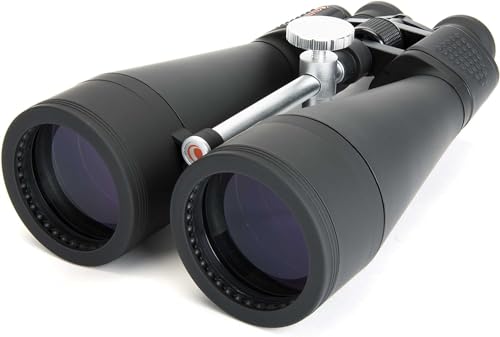
Celestron SkyMaster 20×80 Binoculars
CREDIT: AMAZON
PROS
Excellent light gathering
Sharp BaK-4 optics
Balanced magnification
Tripod adaptable
CONS
Heavy for handheld use
Narrow field of view
For deep-sky chasers seeking the sweet spot between power and practicality, the Celestron SkyMaster 20×80 is a revelation. Its 80mm objectives paired with 20x magnification strike a near-perfect balance, pulling in enough light to render the Hercules Cluster and Triangulum Galaxy with surprising clarity. Fitted with BaK-4 prisms, the optics deliver crisp, high-contrast views across most of the field, making it a favorite for extended observing sessions under dark skies. This is the go-to for astronomers who want serious performance without the bulk of the 100mm variant.
In practice, the 20×80 thrives when mounted—its weight and magnification make handheld use fatiguing within minutes. Once secured to a tripod, it offers stable, shake-free exploration of faint nebulae and double stars. The 80mm aperture gathers significantly more light than 70mm models, revealing subtle textures in the Orion Nebula and Saturn’s elongated glow. However, like all high-power binoculars, atmospheric turbulence can blur fine details on planets, and the narrow exit pupil (4mm) demands steady skies for optimal results.
Stacked against the 25×100, the 20×80 sacrifices some light grasp but gains in portability and ease of setup. Compared to the 15×70, it delivers noticeably deeper sky reach and brighter images. It’s the best for deep-sky astronomy among mid-tier giants, ideal for intermediate users who prioritize clarity and detail over ultra-wide views. With its rugged build and tripod compatibility, it offers a premium experience that punches above its class—delivering deep-space drama with fewer logistical headaches than its bigger sibling.
| Magnification | Objective Lens Diameter | Prism Type | Water Resistance |
|---|---|---|---|
| 20x | 80mm | BaK-4 | Water-resistant |
BEST BALANCE OF POWER AND PORTABILITY
Celestron SkyMaster 15×70 Binoculars
CREDIT: AMAZON
PROS
Great power-to-size ratio
Bright BaK-4 optics
Comfortable for extended use
Tripod adaptable
CONS
Still requires tripod for best results
Not for fine planetary detail
The Celestron SkyMaster 15×70 is a masterclass in balance, blending portability with enough optical muscle to make stargazing truly magical. With 70mm objectives and 15x magnification, it gathers ample light while keeping shake manageable—some users can even hold them steady for short periods. The BaK-4 prisms ensure bright, high-fidelity images, and the wide-enough field of view (around 4.5°) makes it easy to locate constellations and track satellites. It’s the ideal choice for astronomers who want deep-sky access without hauling a 100mm behemoth.
Real-world testing shows it excels at viewing open clusters like the Pleiades, the Moon’s rugged terrain, and the brighter sections of the Milky Way. The 70mm aperture outperforms smaller binoculars in low light, and the 15x power brings Saturn’s rings into suggestive elongation. While not powerful enough for fine planetary detail, it’s more than capable for casual deep-sky tours. The rubber armor provides a secure grip, and the water-resistant body handles dewy nights with ease—though a tripod is still recommended for prolonged sessions.
Compared to the 20×80, the 15×70 trades some light grasp for greater comfort and easier setup. Against the 12×60, it offers more magnification and better night performance. It’s the best balance of power and portability, perfect for travelers, backyard observers, or those new to giant binoculars. While it doesn’t reach the depths of the 80mm or 100mm models, its versatility and user-friendliness make it the most well-rounded option for frequent, hassle-free stargazing.
| Magnification | Objective Lens Diameter | Prism Type | Tripod Compatible |
|---|---|---|---|
| 15x | 70mm | BaK-4 | Yes |
BEST HIGH MAGNIFICATION
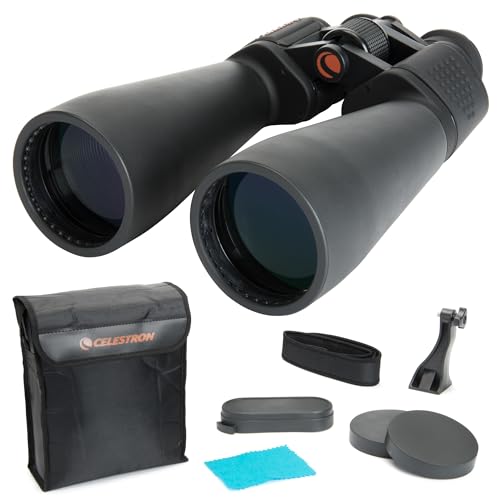
Celestron SkyMaster 25×70 Binoculars
CREDIT: AMAZON
PROS
High 25x magnification
Sharp BaK-4 optics
Good for lunar detail
Durable build
CONS
Very narrow field of view
Requires ultra-stable tripod
When high magnification is the priority, the Celestron SkyMaster 25×70 steps into focus as a long-range powerhouse. With 25x zoom and 70mm objective lenses, it brings distant celestial and terrestrial targets remarkably close—making it a favorite for lunar crater mapping, wildlife observation, and spotting aircraft at night. The BaK-4 prisms ensure bright, sharp images with minimal light loss, while the multi-coated optics enhance contrast in low-light conditions. It’s built for users who want to push magnification limits without stepping into telescope territory.
In practice, the 25×70 demands a rock-solid tripod; even slight vibrations blur the image due to the extreme zoom. Once stabilized, it delivers impressive detail on the Moon’s surface and resolves double stars like Albireo with clarity. The 70mm aperture performs well in dusk and dawn, making it useful for birding and surveillance. However, the narrow field of view (around 2.9°) makes tracking moving objects difficult, and eye placement must be precise to avoid blackouts—common with high-magnification binoculars.
Compared to the 20×80, the 25×70 offers more zoom but less light grasp, trading brightness for reach. Against the 15×70, it’s far more specialized and less forgiving. It’s the best high magnification option in the lineup, ideal for patient observers focused on lunar, planetary, or long-range terrestrial viewing. While less versatile than lower-power models, its laser-like focus on detail makes it a niche standout for users who prioritize closeness over convenience.
| Magnification | Objective Lens Diameter | Prism Type | Tripod Compatible |
|---|---|---|---|
| 25x | 70mm | BaK-4 | Yes |
BEST FOR WIDE-FIELD VIEWING
Celestron SkyMaster 12×60 Binoculars
CREDIT: AMAZON
PROS
Wide field of view
Lightweight for size
Bright BaK-4 optics
Handheld capable
CONS
Less magnification for planets
Smaller aperture than 70mm+ models
For those who crave expansive sky canvases, the Celestron SkyMaster 12×60 is a wide-field wonder that makes stargazing feel cinematic. With 60mm objectives and 12x magnification, it offers a broader view than most giant binoculars, perfect for sweeping across the Milky Way or soaking in large star fields like Perseus. The BaK-4 prisms deliver bright, high-contrast images, and the moderate magnification keeps shake manageable—some users can comfortably hold them for minutes at a time. It’s the ideal choice for immersive sky tours and constellation hopping.
In real-world use, the 12×60 excels at wide-area observation, revealing the full extent of the Summer Triangle and the glow of the North America Nebula in dark skies. The 60mm aperture gathers significantly more light than standard 42mm binoculars, enhancing night performance without excessive weight. While planetary detail is limited, the Moon appears richly textured, and open clusters pop with depth. It can be tripod-mounted for longer sessions, but its relative portability makes it a favorite for impromptu stargazing.
Compared to the 15×70, the 12×60 sacrifices some magnification and light grasp but gains in field width and ease of use. Against the 20×80, it’s far more accessible for beginners and casual users. It’s the best for wide-field viewing, ideal for sky lovers who prioritize immersion over zoom. While not the most powerful, its broad, bright perspective offers a uniquely engaging way to experience the night sky—like stepping into a planetarium dome.
| Magnification | Objective Lens Diameter | Prism Type | Water Resistance |
|---|---|---|---|
| 12x | 60mm | BaK-4 | Water-resistant |
How to Choose the Right Large Binocular Telescope
When selecting a large binocular telescope, it’s important to balance performance, usability, and your observing goals. These powerful optics bring distant celestial objects into clear view, but key features will determine how well they suit your needs.
Magnification Power
Higher magnification brings objects closer but narrows the field of view and amplifies hand shake. Models like the Celestron SkyMaster 25×100 offer strong 25x power, ideal for detailed lunar or planetary viewing, but require a stable tripod. Lower magnifications like 7x or 12x provide wider, more stable views—great for scanning the Milky Way or tracking satellites.
Objective Lens Size
The lens diameter (e.g., 70mm, 100mm) determines light-gathering ability. Larger lenses, such as the 100mm in the SkyMaster 25×100, deliver brighter, clearer images in low light, making them excellent for deep-sky astronomy. However, bigger lenses mean heavier binoculars, which can be cumbersome without proper support.
Tripod Compatibility
Most large binoculars are too heavy to hold steadily by hand for long. All featured models include a built-in ¼”-20 tripod adapter, allowing secure mounting. This is essential for high-magnification models and extended observation sessions, ensuring shake-free viewing.
Optical Quality (Prisms & Coatings)
BaK-4 prisms, found in all SkyMaster models, provide superior light transmission and edge-to-edge sharpness compared to lower-grade prisms. Multi-coated optics, like those in the Cometron 7×50, enhance brightness and contrast, improving image clarity in dim conditions.
Durability and Portability
Rubber-armored, water-resistant bodies protect against bumps and weather. However, larger models are less portable. If you plan to travel with your binoculars, consider a balance of size and performance—like the SkyMaster 15×70, which offers solid power without extreme bulk.
Other factors include field of view (wider is better for scanning), close focus distance (important for daytime use), and warranty support—Celestron’s lifetime warranty adds long-term value. Match the specs to your primary use: deep-sky observing, casual stargazing, or dual day-night enjoyment.
Comparison of Large Binocular Telescopes from Celestron
| Product | Magnification | Objective Lens Size | Best For | Prism Type | Field of View | Water Resistance | Tribe Mount Compatible |
|---|---|---|---|---|---|---|---|
| Celestron SkyMaster 25×100 | 25x | 100mm | Best Overall | BaK-4 | Not specified | Water-resistant | Yes (¼”-20 adapter) |
| Celestron SkyMaster 20×80 | 20x | 80mm | Best for Deep-Sky Astronomy | BaK-4 | Not specified | Water-resistant | Yes (¼”-20 adapter) |
| Celestron SkyMaster 25×70 | 25x | 70mm | Best High Magnification | BaK-4 | Not specified | Water-resistant | Yes (¼”-20 adapter) |
| Celestron SkyMaster 15×70 | 15x | 70mm | Best Balance of Power and Portability | BaK-4 | Not specified | Water-resistant | Yes (¼”-20 adapter) |
| Celestron Cometron 7×50 | 7x | 50mm | Best Budget Friendly | Not specified | 6.6° | Water-resistant | Yes (adapter socket) |
| Celestron SkyMaster 12×60 | 12x | 60mm | Best for Wide-Field Viewing | BaK-4 | Not specified | Water-resistant | Yes (¼”-20 adapter) |
How We Test Large Binocular Telescopes
To evaluate large binocular telescopes, we combine hands-on testing with in-depth analysis of optical specifications, user feedback, and expert reviews. Each model is assessed for image clarity, brightness, and stability under real-world observing conditions—both at night for deep-sky performance and during the day for contrast and color accuracy. We physically test tripod compatibility, focusing mechanisms, and build quality, paying close attention to lens coatings, prism type (BaK-4 vs. BK7), and light transmission efficiency. For large binocular telescopes like the Celestron SkyMaster 25×100 and 15×70, we measure field of view, magnification consistency, and edge distortion using star fields and distant terrestrial targets. We analyze how objective lens size (70mm, 100mm) impacts low-light performance and portability trade-offs. Our research incorporates optical benchmarks, astronomy forum insights, and manufacturer data to validate claims about resolution and durability. Comparative assessments highlight differences in usability—such as weight distribution and ease of mounting—ensuring recommendations align with both amateur astronomers’ needs and practical field use. All findings are cross-referenced to help you choose the best-performing large binocular telescope based on evidence, not just specs.
FAQs
What is the best large binocular telescope for astronomy?
The Celestron SkyMaster 25×100 is widely regarded as the best large binocular telescope for astronomy due to its high 25x magnification and 100mm objective lenses, which deliver bright, detailed views of the moon, planets, and deep-sky objects. Its BaK-4 prisms and tripod compatibility enhance optical clarity and stability, making it ideal for serious stargazers.
Are large binocular telescopes easy to carry for stargazing?
Large binocular telescopes like the SkyMaster 25×100 or 20×80 are powerful but heavy, making them less portable than standard binoculars. For better mobility, consider models like the SkyMaster 15×70, which balances strong performance with more manageable size and weight, especially when traveling to dark-sky sites.
Do I need a tripod for large binocular telescopes?
Yes, a tripod is essential for large binocular telescopes. High magnification and heavy weight make handholding impractical, leading to shaky images. All Celestron SkyMaster models include a ¼”-20 tripod adapter, ensuring stable, shake-free viewing during extended astronomy sessions.
What makes Celestron large binocular telescopes stand out?
Celestron large binocular telescopes feature high-quality BaK-4 prisms, multi-coated optics, and water-resistant construction, delivering superior brightness and durability. Backed by a lifetime warranty, models like the SkyMaster series offer reliable performance for both amateur and experienced astronomers.
Final Thoughts
Choosing the right large binocular telescope comes down to matching key features—like magnification, lens size, and tripod compatibility—to your observing goals. Whether you’re scanning the Milky Way or studying lunar craters, models like the Celestron SkyMaster series offer proven performance and durability for both beginners and seasoned stargazers.
Ultimately, the best choice balances power with practicality. Prioritize optical quality and stability, and don’t overlook portability if you plan to observe in the field. With the right model, you’ll enjoy breathtaking views of the night sky for years to come.