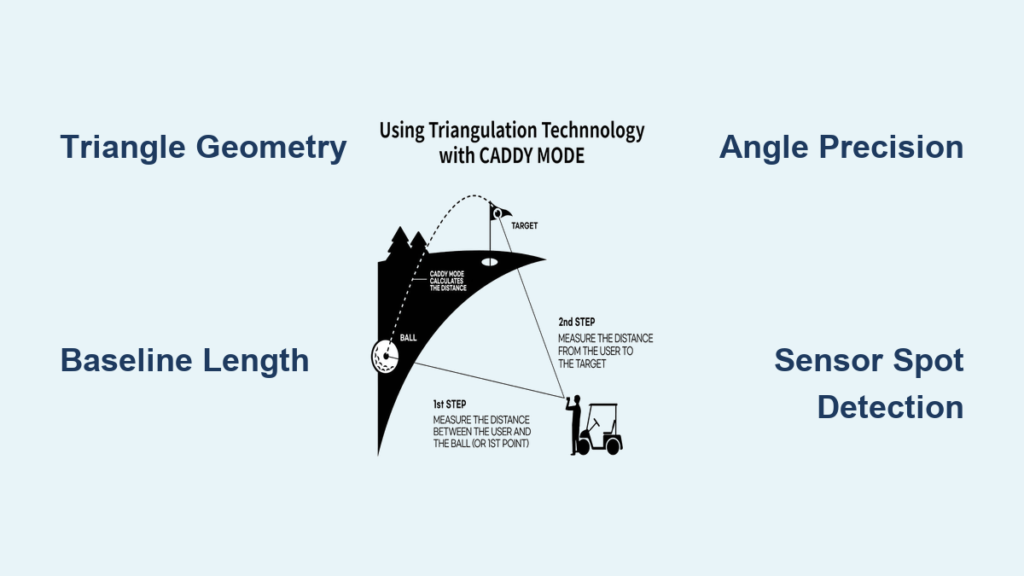
You’re standing on a hilltop, trying to measure the distance to a distant tower. Without a tape measure or GPS, how do you calculate that exact distance? The answer lies in an age-old principle: range finder triangulation. This method powers everything from handheld laser rangefinders to military targeting systems and surveying equipment. At its core, range finder triangulation uses geometry, specifically the properties of triangles, to determine unknown distances with remarkable accuracy.
In this guide, you’ll learn how triangulation drives modern rangefinding, how different technologies implement it, and what factors affect its accuracy. You’ll also discover which applications still rely on this centuries-old technique and why it remains essential in robotics, manufacturing, and surveying today.
The Core Geometry Behind Range Finder Triangulation

Triangulation relies on forming a triangle between two known reference points and a target. Once the angles at the base are measured, the distance to the target can be calculated using trigonometry. This simple geometric idea has powered distance measurement for centuries.
Triangle Geometry Explained
A triangle has three sides and three angles. If you know the length of one side (the baseline) and the angles at each end, the rest of the triangle, including the distance to the target, can be determined. This is the foundation of every range finder triangulation system.
The Role of the Baseline
The baseline is the fixed distance between two observation points. A longer baseline increases measurement accuracy because small angular errors have less impact on distance calculations. Handheld devices often use folded optical paths to maximize baseline length without increasing physical size.
Angle Measurement Precision
Precision in angle measurement is crucial. Even a tiny error, like 0.1 degree, can lead to large distance miscalculations over long ranges. High-quality optics and digital sensors help minimize these errors and keep readings consistent.
Types of Triangulation Rangefinders
Different rangefinders use variations of triangulation depending on application, size, and required precision. Each design offers unique tradeoffs between accuracy, portability, and ease of use.
Coincidence Rangefinders
Used primarily in early 20th-century military applications, coincidence rangefinders rely on human vision to align two images into one. The operator adjusts the device until both halves of the target image match, and the internal mechanism calculates distance based on the adjustment angle.
Manual Image Alignment Process
The user looks through an eyepiece and sees a split image. Rotating a dial moves one half of the image until it aligns perfectly with the other. The dial’s position corresponds directly to the target distance.
Optical Path Splitting
Light enters through two lenses spaced apart, forming the baseline. Mirrors and prisms direct each beam into a single viewing path, allowing side-by-side or overlapping comparison of the two images.
Stereoscopic Rangefinders
These devices present separate images to each eye, creating a 3D effect. The operator perceives depth and adjusts focus until the target appears sharp and aligned in space.
Human Depth Perception Use
Stereoscopic models take advantage of natural binocular vision. Trained users can detect misalignment more quickly than in coincidence types, but performance depends on user experience and eye health.
Limitations in Low Visibility
Fog, rain, or poor lighting reduce image clarity, making alignment difficult. These conditions significantly degrade stereoscopic rangefinder effectiveness and can produce unreliable readings.
Modern Laser Rangefinders and Active Triangulation
While many modern laser rangefinders use time-of-flight measurement, some compact or short-range models still employ triangulation, especially in robotics and industrial automation.
Active Triangulation Method

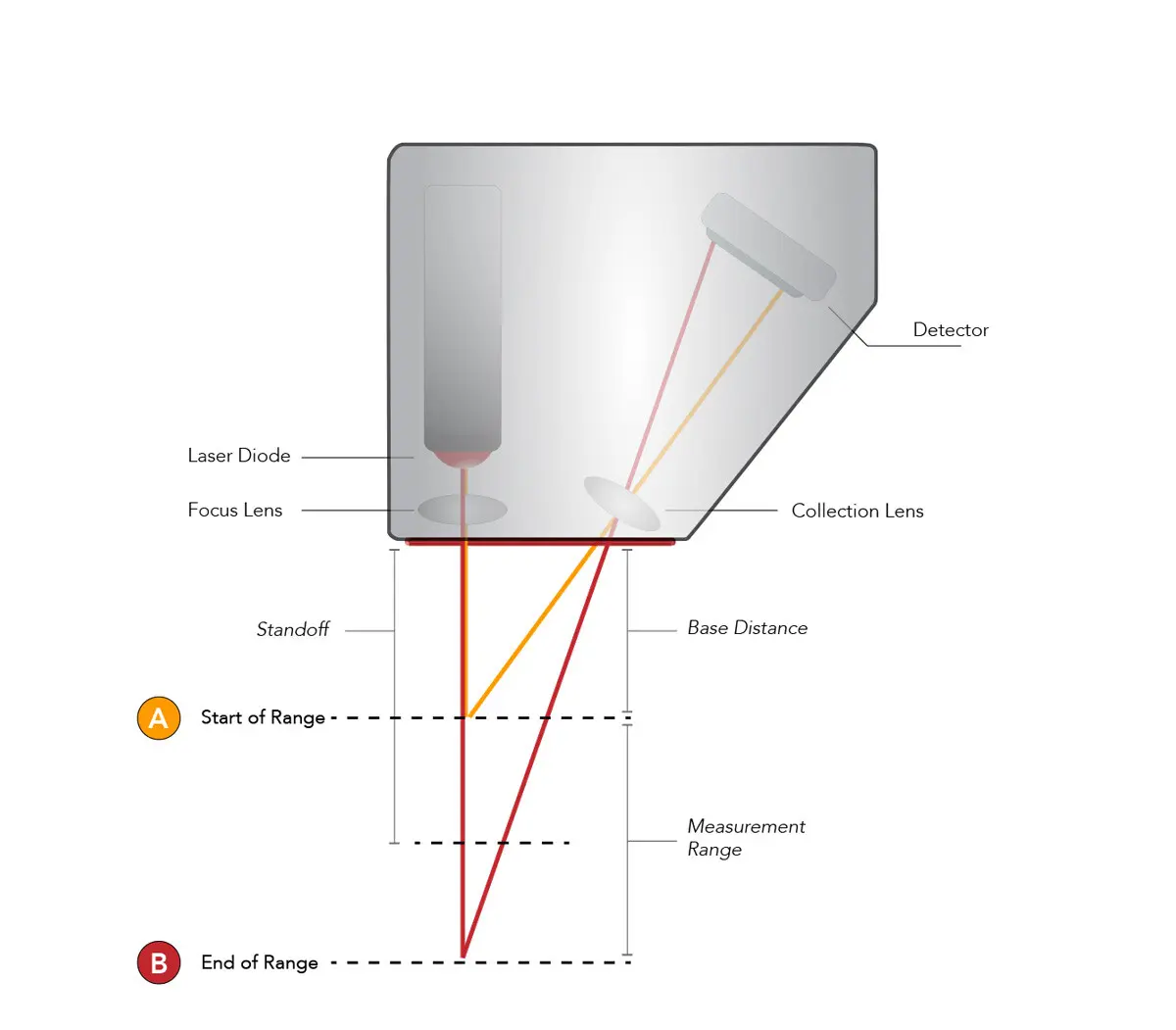
In active triangulation, a laser dot is projected onto a target. A sensor located at a known offset from the laser source detects the position of the reflected spot. Using the known angle and baseline, the system computes distance instantly.
Sensor Spot Detection
A position-sensitive detector (PSD) or CMOS sensor array captures where the laser dot appears. The further the target, the more the spot shifts on the sensor, enabling accurate distance calculation.
Short-Range High Precision
Active triangulation excels at close distances, typically under 10 meters, offering sub-millimeter accuracy. It’s commonly used in manufacturing, 3D scanning, and robotic navigation systems.
Pro Tip: If you need micron-level precision for inspection tasks, active triangulation outperforms most time-of-flight systems at close range.
Optical Design Principles in Triangulation Systems
The physical layout of lenses, sensors, and emitters determines performance and range capability. Smart optical engineering makes modern triangulation devices compact yet accurate.
Lens Alignment Requirements
Misaligned lenses distort angle measurements, leading to inaccurate results. Precision mounts and factory calibration ensure consistent optical paths across the device’s lifetime.
Baseline Length vs. Device Size
Longer baselines improve accuracy but require larger devices. Handheld units balance size with effective baseline length, often using folded optical paths to save space without sacrificing precision.
Parallax Error Reduction
Parallax occurs when the viewing axis doesn’t match the measurement axis. High-end rangefinders correct for this through calibrated offsets or dual-axis alignment systems built into the optics.
Environmental and Mechanical Factors Affecting Accuracy
Even well-designed systems face challenges that impact performance. Understanding these factors helps you get reliable readings in real-world conditions.
Target Surface Reflectivity
Highly reflective or dark surfaces alter how light returns to the sensor. Matte, medium-reflectivity targets yield the most reliable readings across all triangulation methods.
Atmospheric Conditions
Heat haze, humidity, and air turbulence bend light slightly in a phenomenon called refraction. Over long distances, this skews angle measurements and introduces noticeable error.
Vibration and Stability
Hand tremors or unstable mounting cause angular jitter during measurement. Tripods or vibration-dampening housings help maintain steady aim and prevent false readings.
Real-World Applications of Triangulation Rangefinders
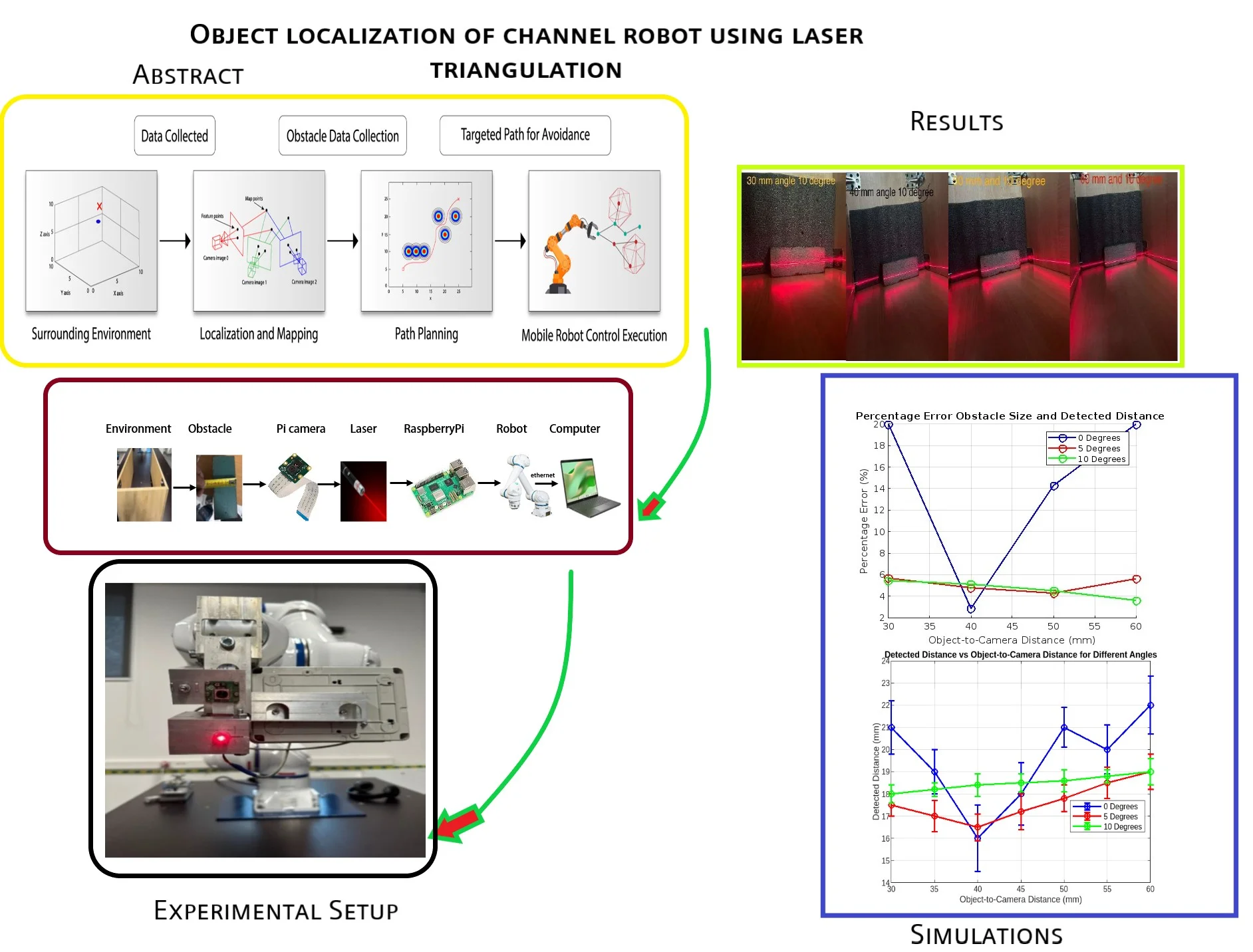
Though surpassed by time-of-flight lasers in many fields, range finder triangulation remains vital in specific niches where precision matters more than range.
Surveying and Mapping
Surveyors use triangulation principles in total stations, combining angle and distance measurements from known control points to map terrain accurately.
Integration with GPS Data
Modern survey tools merge triangulated measurements with GPS coordinates for enhanced positional accuracy, especially in obstructed areas like forests or urban canyons.
Military and Defense
Historically, large optical rangefinders on battleships used triangulation to aim artillery. While largely replaced by radar and lidar, the principle still informs modern targeting algorithms.
Legacy Naval Fire Control
Battleships like the USS Iowa used 15-meter coincidence rangefinders to determine enemy ship distance before firing. These were critical components of analog fire-control computers.
Robotics and Automation
Robotic arms and autonomous vehicles use active triangulation sensors for obstacle detection and object positioning in dynamic environments.
3D Scanning and Profiling
Triangulation-based scanners project laser lines across surfaces while cameras capture deformation. Software converts these distortions into detailed 3D models used in reverse engineering and quality control.
Why Triangulation Still Beats Time-of-Flight in Some Cases
Despite newer technologies, range finder triangulation offers unique benefits in specific scenarios that keep it relevant today.
Faster Response at Close Range
Triangulation doesn’t require timing ultra-fast light pulses. For short distances, it provides near-instantaneous readings without complex timing electronics.
Lower Power Consumption
Without the need for high-speed clocks or powerful lasers, triangulation systems often consume less energy, making them ideal for battery-powered portable devices.
Simpler Electronics
Analog triangulation systems can operate without microprocessors, increasing reliability in extreme environments where digital components might fail.
Limitations and Calibration Requirements
No technology is perfect. Triangulation has inherent constraints that limit its use in some applications and require regular maintenance.
Limited Effective Range
As distance increases, the angle change becomes negligible. Beyond 100 to 200 meters, range finder triangulation loses precision compared to time-of-flight methods.
Sensitivity to Alignment
Any shift in lens or sensor position affects accuracy. These systems require frequent calibration, especially after physical shock or rough handling.
Dependency on Target Visibility
Triangulation requires a clear line of sight and a visible target. Smoke, fog, or camouflage can render it ineffective in the field.
Calibration and Maintenance Best Practices
Proper upkeep ensures long-term accuracy and reliability for any triangulation-based device you depend on.
Regular Optical Inspection
Check lenses for scratches, dust, or misalignment. Clean optics with appropriate tools to avoid damaging delicate coatings.
Baseline Verification
Use known-distance test targets to verify that readings remain accurate over time. A simple 5-meter or 10-meter test range can catch drift early.
Professional Recalibration Schedule
For critical applications like surveying or defense, schedule annual or semi-annual recalibration by certified technicians to maintain peak performance.
Frequently Asked Questions About Range Finder Triangulation
What is range finder triangulation in simple terms?
Range finder triangulation is a distance measurement method that uses triangle geometry. By knowing the distance between two observation points and measuring the angles to a target, you can calculate the target’s distance using trigonometry.
How accurate is triangulation compared to laser rangefinding?
Active triangulation offers sub-millimeter accuracy at close range (under 10 meters). However, beyond 100 to 200 meters, time-of-flight lasers generally provide better precision because angular changes become too small to measure reliably.
What’s the main difference between triangulation and time-of-flight?
Triangulation measures angles and uses geometry to compute distance, while time-of-flight measures how long a light pulse takes to return. Triangulation excels at short range with high precision, while time-of-flight works better over long distances.
Why do surveyors still use triangulation principles?
Surveyors use triangulation because it integrates naturally with total stations and angle-measuring equipment. Combined with GPS data, it provides reliable positional accuracy even in obstructed environments where satellite signals struggle.
Can range finder triangulation work in fog or rain?
Triangulation performance drops significantly in fog, rain, or low visibility. These conditions scatter light and obscure the target, making accurate angle measurement difficult or impossible.
How often should you calibrate a triangulation rangefinder?
For professional use, schedule recalibration at least once per year. After any physical shock, drop, or extended storage, perform a baseline verification before relying on the device for critical measurements.
Key Takeaways for Mastering Range Finder Triangulation

Range finder triangulation combines centuries-old geometry with modern optics to deliver precise distance measurements. The method works by forming a triangle with a known baseline, measuring angles to the target, and applying trigonometry to compute distance. Active triangulation systems achieve sub-millimeter accuracy at close range, making them ideal for robotics, manufacturing, and 3D scanning.
The technology shines in short-range, high-precision applications where time-of-flight lasers are overkill. However, environmental factors like fog, vibration, and target reflectivity can affect accuracy, so proper calibration and stable mounting matter. Choose range finder triangulation when you need fast, low-power, high-precision readings within 10 meters, and pair it with regular maintenance for long-term reliability.
Your next step: Pick a known-distance target and test your current rangefinder against it. You’ll quickly see whether your device needs recalibration or whether range finder triangulation is the right tool for your next project.