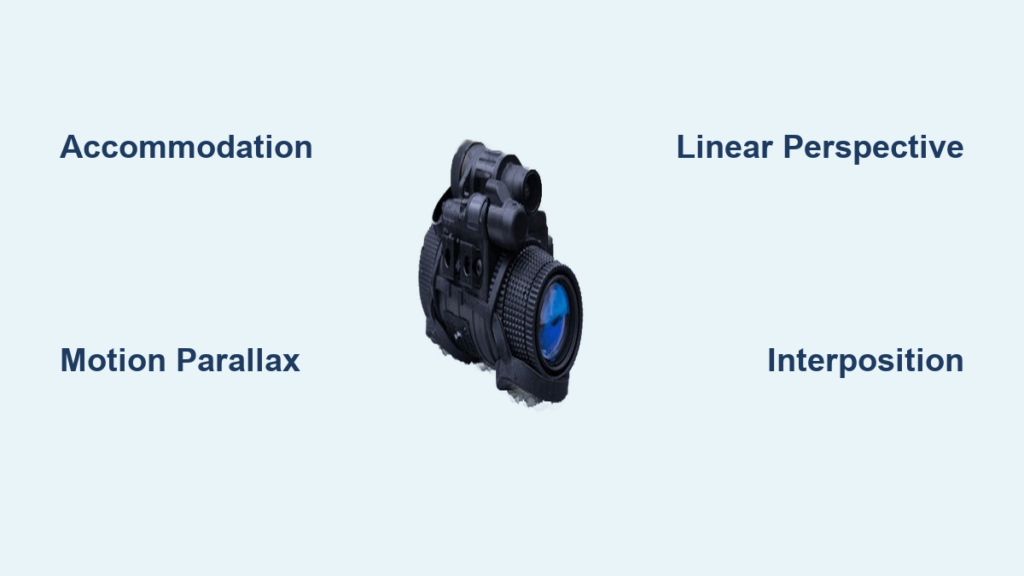
Losing vision in one eye can feel like stepping into a flatter, less predictable world. Suddenly, depth cues falter, stairs seem ambiguous, and reaching for a cup might result in a miss. Yet millions of people live full, active lives with monocular vision—seeing clearly through just one eye. So how does it work? Unlike binocular vision, which relies on both eyes to create 3D perception through stereoscopic depth, monocular vision uses a powerful combination of visual cues, brain adaptation, and learned behaviors to interpret space and distance. From the way light and shadow define shape to how motion reveals proximity, the brain compensates remarkably well. This guide explores the science behind one-eyed sight, the real-world challenges, and how both humans and animals adapt—proving that depth isn’t just in the eyes, but in the mind.
Brain Uses Monocular Depth Cues to Judge Distance

Without two eyes, the brain can’t rely on stereopsis—the slight difference in images between left and right eyes that enables precise depth judgment. But it doesn’t give up. Instead, it shifts to using monocular depth cues, visual signals that work with a single eye. These cues are less accurate than binocular vision, especially up close, but together they allow functional navigation, object interaction, and environmental awareness.
Your brain has spent a lifetime learning these cues, even when both eyes were working. Now, with only one eye, it becomes more attentive, refining its use of size, motion, shading, and perspective to build a reliable mental map of space. Over time, especially after vision loss, this interpretive system improves—helping you judge distances, avoid obstacles, and move confidently.
Accommodation Provides Physical Feedback on Focus
One of the most direct monocular depth cues is accommodation—the physical effort your eye makes to focus on nearby objects. When you look at something close, like a book or a needle, the ciliary muscle inside your eye contracts to change the lens shape. The brain receives sensory feedback from this muscle activity, using it as a signal of how near the object is.
The closer the object, the more muscular effort is required—so greater strain tells the brain the item is within arm’s reach. This cue is most effective within three feet, making it crucial for reading, writing, or threading. However, accommodation fades in usefulness beyond that range, where other cues take over.
Motion Parallax Helps Separate Near and Far Objects
As you move your head or walk forward, objects at different distances shift across your vision at varying speeds. This phenomenon, called motion parallax, is one of the most reliable depth cues in monocular vision.
Closer objects—like trees, signs, or furniture—appear to move rapidly across your field of view. Distant objects—such as mountains or buildings—seem almost stationary. Your brain uses this relative motion to distinguish layers of depth. For example, when driving, motion parallax helps you judge how close a curb is, even with only one eye. It’s why turning your head side to side while walking can improve spatial awareness.
Linear Perspective Shows How Space Recedes
Parallel lines—like railroad tracks, hallway edges, or city streets—appear to converge as they stretch into the distance. This optical illusion, known as linear perspective, signals depth and distance to the brain.
The point where these lines meet, called the vanishing point, helps your brain estimate how far a scene extends. Architects and artists use this principle intentionally, but your visual system uses it automatically. Whether you’re judging the length of a corridor or the distance to a stop sign, linear perspective provides a strong clue about spatial layout.
Interposition Reveals Which Objects Are Closer
When one object blocks part of another, your brain instantly knows the blocking object is nearer. This cue, called interposition or overlapping, is simple but highly effective.
For instance, if a chair appears to cut across a table in your view, you perceive the chair as being in front. This allows rapid, intuitive judgments about spatial order—especially useful in cluttered environments like a busy kitchen or crowded sidewalk.
Texture Gradient Indicates Surface Distance
Surfaces change in appearance with distance. Up close, textures are sharp and detailed—individual blades of grass, pebbles on a path, or weave in fabric. As distance increases, these details blur and compress, becoming smoother and less distinct.
This shift is known as texture gradient, and it helps your brain estimate how far a surface extends. A gravel driveway that looks coarse near your feet but fades into a gray blur ahead signals that it’s receding into the distance. This cue is especially helpful outdoors or in large indoor spaces.
Relative Size Helps Estimate Object Distance
If two objects are known to be the same actual size—like cars, people, or cups—the one that appears smaller on your retina is likely farther away. Your brain uses stored knowledge about object sizes to make this judgment.
For example, if you see two people walking and one looks much smaller, you assume they’re more distant. This cue works best when familiar objects are present, but it can be misleading if size assumptions are wrong—such as mistaking a child for a faraway adult.
Shading and Shadows Define 3D Shape
Light creates highlights and shadows that reveal an object’s form and position in space. A ball with a shadow beneath it looks round and elevated. A flat surface with even lighting appears flush.
Your brain interprets these shading patterns to judge depth, curvature, and elevation. This is why dim or flat lighting makes steps, curbs, or holes harder to see—without shadows, key depth cues vanish. Using directional lighting at home can restore these signals.
Brightness and Aerial Perspective Signal Distance
Closer objects usually appear brighter and more vivid than distant ones. Atmospheric particles—dust, fog, moisture—scatter light over long distances, making faraway objects look hazier, bluer, and lower in contrast.
This effect, called aerial perspective, is common in landscapes. Distant mountains appear faded compared to nearby hills. Your brain uses this softening to estimate depth in outdoor scenes, helping you judge how far a trail or road extends.
Challenges of Living with One Eye
Despite the brain’s adaptability, monocular vision comes with real limitations. The loss of binocular cues affects depth, motion tracking, and peripheral awareness—impacting daily tasks, especially in the first months after vision loss.
Reduced Depth Perception Up Close
The biggest challenge is the loss of stereopsis, which provides fine depth discrimination within arm’s reach. Without it, tasks like pouring liquids, catching a ball, or parking a car become harder. Spills, misjudged reaches, and delayed reactions are common at first.
With practice, most people improve significantly, but some uncertainty remains—especially in low light or unfamiliar environments.
Limited Peripheral Field Awareness
With only one functioning eye, you lose about half of your side vision on the affected side. This creates a blind spot where movement or objects go undetected.
You may bump into doorframes, miss people approaching, or fail to see vehicles when turning. Compensating requires constant head scanning and environmental awareness.
Impact on Balance and Stability
Vision helps maintain balance by providing spatial orientation. Studies show that even temporary monocular vision—like patching one eye—reduces postural stability.
Patients with glaucoma, cataracts, or stroke-related vision loss often report unsteadiness. The brain relies more on inner ear and body feedback when visual input is reduced, increasing fall risk—especially in dim light or on uneven ground.
Adapting to Life with Monocular Vision

The brain is remarkably adaptable. Most people improve over time, especially with training and strategy. Children adapt fastest, but adults can also regain confidence and independence.
Behavioral Compensation Techniques
- Head scanning: Turn your head side to side before moving or crossing streets.
- Environmental scanning: Look around deliberately before stepping or reaching.
- Tactile feedback: Use handrails, walls, or touch to confirm position.
- Improved lighting: Use bright, directional light to enhance shadows and depth cues.
- Defensive driving: Increase following distance and use mirrors more.
Vision Rehabilitation and Training
Eye care professionals may recommend:
– Depth perception drills: Reaching for objects at varying distances.
– Hand-eye coordination exercises: Catching balls or stacking blocks.
– Occupational therapy: For cooking, dressing, or mobility.
– Magnification tools: For reading or detailed work.
Early intervention leads to better outcomes.
Driving with Monocular Vision
You can legally drive with one eye in all 50 U.S. states—if you meet visual acuity and field requirements. However, studies show monocular drivers have up to seven times more accidents than binocular drivers due to reduced depth and motion judgment.
Safety Tips
- Increase following distance
- Avoid night driving
- Use mirrors more frequently
- Limit high-speed roads
- Practice in low-risk areas
Some states require a behind-the-wheel evaluation. Always consult your eye doctor.
Technology Mimics Monocular Depth
AI and robotics use monocular depth estimation to “see” in 3D from a single camera. Neural networks analyze perspective, texture, and shading—just like the human brain.
Applications include self-driving cars, drones, and assistive devices that warn of obstacles or announce step changes for the visually impaired.
Monocular vision works through a blend of physiological feedback, learned cues, and behavioral adaptation. While it lacks the precision of two-eyed sight, the brain compensates powerfully—allowing navigation, coordination, and independence. With awareness, training, and support, individuals with one eye can live fully and safely.