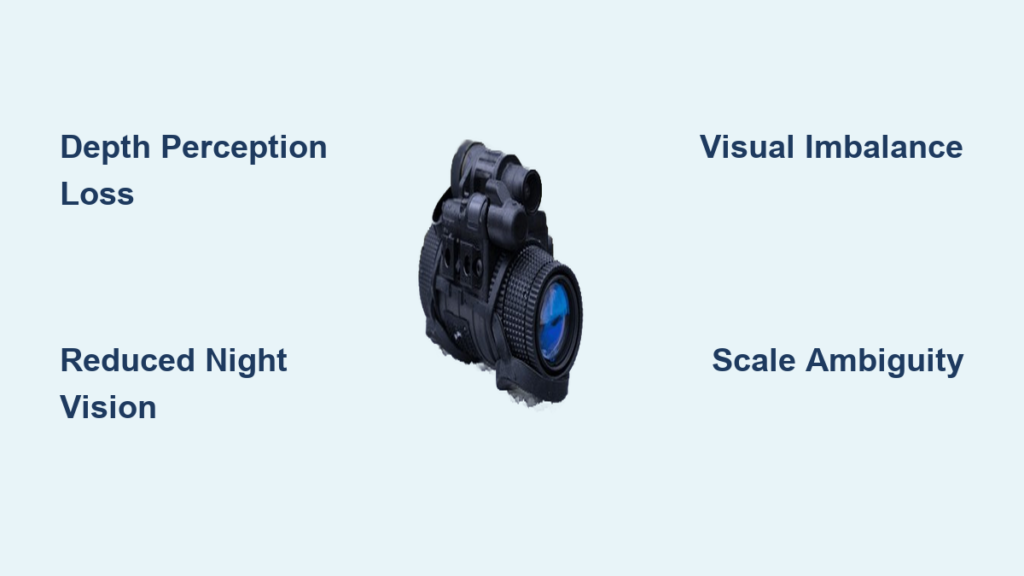
For millions of people and countless machines, vision depends on just one eye. Whether due to medical necessity, surgical correction, or technological design, monocular vision—relying on a single eye or camera—offers practical benefits but comes with significant trade-offs. Unlike binocular vision, which uses both eyes to create depth perception and rich spatial awareness, monocular vision operates with limited input. This affects how people judge distances, how drivers navigate roads, and how robots interpret their surroundings. From patients correcting age-related farsightedness to engineers building autonomous drones, understanding the advantages and disadvantages of monocular vision is crucial. This guide explores its impact across three key areas: clinical monovision, natural one-eye vision, and technological single-camera systems, helping you weigh the pros and cons for health, safety, and innovation.
Clinical Monovision: Pros and Cons

Restores Near Vision Without Full Nearsightedness
As people age, presbyopia—the gradual loss of the eye’s ability to focus on close objects—typically begins around age 40. To combat this, monovision (or “blended vision”) corrects one eye for distance and the other for near tasks. The dominant eye usually handles far vision, while the secondary eye is adjusted for reading or screen work. This approach avoids making both eyes nearsighted, which would blur distance vision. By maintaining one clear eye for each range, patients can see well at multiple distances—without relying on bifocals or reading glasses.
Reduces Dependence on Glasses
One of the biggest benefits of monovision is freedom from multiple pairs of eyewear. Patients report needing fewer:
– Reading glasses
– Bifocals
– Computer-specific lenses
This independence simplifies daily life, especially for tasks like driving, cooking, or checking your phone. Many users enjoy the convenience of grabbing their car keys without fumbling for glasses.
Customizable Based on Lifestyle Needs
Monovision isn’t one-size-fits-all. Eye doctors tailor the correction to match your routine:
– Artists may prefer near vision in their dominant eye for detailed work.
– Drivers often keep distance vision in the dominant eye.
– Office workers might optimize for intermediate screen focus.
This flexibility ensures the correction supports your real-world needs.
Trial Period Before Surgery
You can test monovision with contact lenses before committing to surgery. This low-risk trial lets you experience real-world performance—reading menus, checking dashboards, or navigating stairs. If discomfort or imbalance occurs, simply switch back to your regular lenses. This trial phase is essential for determining long-term tolerance.
Long-Term Cost Savings
By reducing the need for multiple prescription glasses and frequent replacements, monovision lowers ongoing eye care costs. While procedures like LASIK or cataract surgery with IOL implants have upfront fees, they often pay for themselves over time—especially for those who once owned several pairs of specialty lenses.
Improves Quality of Life
Many patients report higher satisfaction after adapting. They feel more confident in social settings, less frustrated switching glasses, and more capable during daily tasks. The psychological boost from visual independence significantly enhances overall well-being.
Treats Cataracts and Presbyopia Together
During cataract surgery, doctors can implant monovision intraocular lenses (IOLs) to correct both clouded vision and age-related focusing issues. This dual benefit means one procedure addresses two common aging eye conditions, streamlining recovery and improving vision faster.
Hard to Adapt to Visual Imbalance
Not everyone adjusts well. The brain struggles to merge mismatched images, leading to:
– Eye strain
– Headaches
– Dizziness
About 10–20% of people cannot tolerate monovision long-term. Symptoms often peak in the first few weeks, making the trial period critical.
Reduced Depth Perception (Stereopsis Loss)
Stereopsis—the brain’s ability to compare images from both eyes—gives us 3D vision. Monovision weakens this because one eye is always out of focus. As a result, tasks like pouring coffee, parking a car, or catching a ball become harder due to impaired depth judgment.
Lower Contrast Sensitivity
With only one eye providing sharp input, image quality drops. This leads to:
– Blurred edges
– Poorer distinction between light and dark
– Difficulty seeing in dim lighting
These issues are especially noticeable at night or in fog.
Risk of the Pulfrich Effect
When one eye sees a blurred image and the other a clear one, the brain processes signals at different speeds. This causes the Pulfrich effect, where moving objects appear to travel in elliptical paths. For example:
– A swinging pendulum may look like it’s orbiting
– Cars on a highway might seem closer or farther than they are
This distortion increases accident risk, particularly while driving.
Night Vision Problems
After LASIK or cataract surgery, many patients report:
– Glare around headlights
– Halos around streetlights
– Starburst patterns from bright lights
These effects stem from optical aberrations and worsen in low light.
Permanent Surgical Changes
Unlike contact lens trials, LASIK, PRK, or IOL implantation are not easily reversible. If you’re unhappy, options are limited—some need additional surgery, others return to wearing glasses part-time.
May Still Need Supplemental Glasses
Even successful users often need glasses for:
– Night driving
– Extended computer use
– Fine-detail tasks (e.g., sewing)
Your eye doctor may prescribe situational lenses to fill these gaps.
Living with One-Eye Vision

Neurological Adaptation Takes Time
After losing vision in one eye, your brain must relearn spatial awareness. Adaptation varies:
– Sudden loss causes more disorientation
– Gradual loss allows slower adjustment
– Younger brains adapt faster
Most regain functional vision in weeks, but full confidence can take months.
Uses Monocular Depth Cues
Without stereopsis, the brain relies on alternative clues:
– Relative size: Known object sizes indicate distance
– Texture gradient: Surfaces appear denser when farther
– Motion parallax: Nearby objects move faster across the field
– Shadows and lighting: Help judge shape and depth
These cues allow accurate judgments, though precision remains lower.
Narrower Peripheral Field
One eye means a smaller visual field, especially on the blind side. You may:
– Miss people approaching from the side
– Bump into doorframes
– Fail to see cyclists or vehicles in blind spots
Compensate by turning your head and using mirrors.
Increased Eye Fatigue
The single eye handles all visual input, leading to faster fatigue. Symptoms include:
– Blurry vision after reading
– Discomfort during screen use
– Headaches after driving
Use the 20-20-20 rule: every 20 minutes, look at something 20 feet away for 20 seconds.
Requires Protective Eyewear
Since vision depends entirely on one eye, protecting it is critical. Use:
– Polycarbonate safety glasses during DIY
– UV-blocking sunglasses outdoors
– Protective goggles when playing sports
Annual eye exams help catch early signs of disease.
Driving with Monocular Vision
Legal Requirements (UK – DVLA/DVA)
You can drive with monocular vision if you meet these standards:
– Read a number plate from 20 meters
– Snellen chart: 6/12 or better in the good eye with correction
– Adequate visual field in the functioning eye
– Medical clearance from an ophthalmologist
You must notify the DVLA (or DVA), especially if you hold an HGV or PSV license. Commercial drivers may need a V1V form.
Challenges on the Road
Even with legal approval, monocular drivers face real risks:
– Larger blind spots from vehicle pillars
– Poor depth judgment when merging or parking
– Difficulty judging speed of oncoming traffic
Use wing mirrors, check blind spots manually, and turn your head before changing lanes.
Mitigation Strategies
Improve safety with:
– Wide-angle side mirrors
– Rearview camera systems
– Vehicle proximity sensors
– Defensive driving habits
Practice in low-traffic areas before returning to busy roads.
Technological Monocular Vision Systems

Lightweight and Low-Cost Design
Robots, drones, and mobile devices use single cameras because they:
– Weigh less
– Consume less power
– Fit into compact spaces
Ideal for wearable tech, delivery bots, and surveillance drones.
Lower Processing Demand
A single image stream requires less computational power than stereo pairs. This allows real-time operation on:
– Embedded processors
– Edge computing devices
– Low-power mobile chips
Easier Setup and Calibration
No need to align two cameras. Monocular systems avoid:
– Stereo calibration errors
– Synchronization delays
Faster deployment and fewer failures make them ideal for field robotics.
Wider Field of View
Single cameras can use fisheye or wide-angle lenses to capture broader scenes. Stereo systems are limited by the physical distance between lenses.
Works in Low-Texture Environments
Stereo vision fails on blank walls or cloudy skies. Monocular systems use:
– Visual Odometry (VO)
– Structure from Motion (SfM)
These techniques enable navigation even in featureless spaces.
Tech System Limitations
Cannot Measure Absolute Depth
Monocular systems infer distance using:
– Known object size
– Camera motion
– AI models
Without these, depth remains ambiguous.
Needs Motion to Estimate Depth
If the camera isn’t moving, depth estimation stops. Static scenes provide no parallax data.
Suffers from Scale Ambiguity
A toy car at 1 meter may look identical to a real car at 10 meters. Monocular systems reconstruct relative shape but not true scale.
Less Accurate Than Stereo or LiDAR
Despite AI advances, monocular depth is less precise than:
– Stereo vision
– LiDAR
– Time-of-flight sensors
Errors increase in poor lighting or with reflective surfaces.
Vulnerable to Lighting Changes
Shadows, glare, and flickering light disrupt feature detection. Performance degrades in:
– Sunlight through trees
– Headlights at night
– Flashing emergency lights
Key Takeaways and Advice
For Patients Considering Monovision
- Try contact lenses first
- Discuss eye dominance and lifestyle with your optometrist
- Be honest about night driving needs
- Schedule annual eye exams
For People with One-Eye Vision
- Allow weeks to months for adaptation
- Wear protective eyewear
- Practice head-turning scans
- Take visual breaks during screen use
For Engineers Using Monocular Vision
- Pair cameras with IMUs or GPS
- Use deep learning models for depth
- Implement hybrid SLAM systems
- Consider sensor fusion in critical apps
Final Note: Monocular vision offers practical benefits across medicine, daily life, and technology—but always at the cost of depth and visual richness. Whether you’re a patient, driver, or engineer, success comes from understanding the trade-offs and using alternative cues to fill the gaps. With proper adaptation and safeguards, monocular vision supports independence, efficiency, and innovation.