You are not alone if you have struggled to find a long-range laser range finder circuit for DIY integration. Like many engineers and makers, you might be frustrated that handheld golf or hunting rangefinders cost under $50, yet standalone sensors with UART or SPI output capable of 500+ meters are nearly impossible to source from mainstream distributors. What gives?
The core issue is not a lack of technology. It is a mismatch between consumer-grade packaged devices and the bare components available to hobbyists. Most long-range laser rangefinders use time-of-flight measurement with infrared lasers and sensitive photodetectors, but manufacturers rarely sell the core sensor module separately. This guide breaks down how laser range finder circuits actually work, why components are hard to source, and how to successfully integrate long-range distance sensing into your project.
How Laser Range Finder Circuits Measure Distance
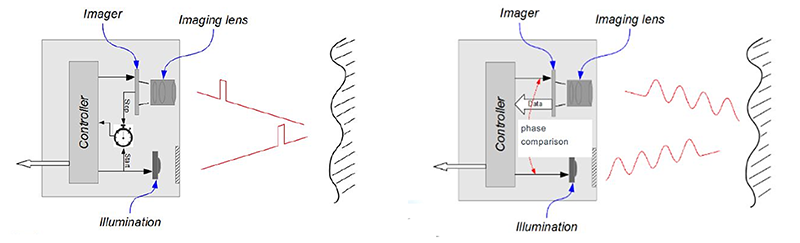
At their core, laser rangefinders calculate distance by measuring how long it takes a pulse of light to travel to a target and back. This method is known as time-of-flight measurement.
Core Components of a Time-of-Flight Circuit

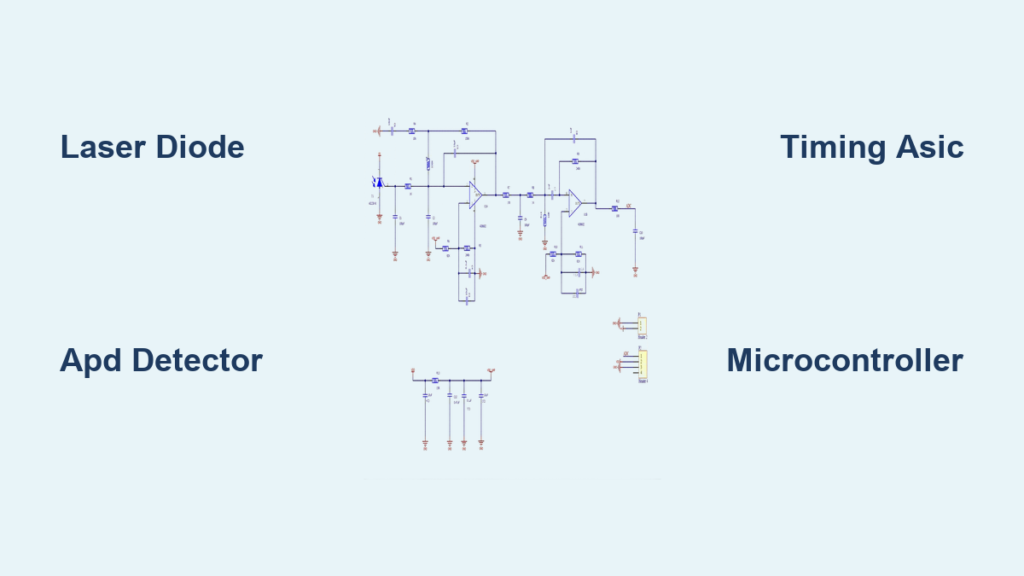
A typical laser range finder circuit includes several key parts working together:
- Laser diode: Emits a short, focused IR pulse, usually at 905 nm
- Driver circuit: Triggers the laser with precise timing
- Photodetector (avalanche photodiode): Captures reflected light
- Timing processor (ASIC or FPGA): Calculates round-trip time
- Microcontroller: Converts time to distance and manages I/O
For a 500-meter measurement, the round-trip time is just 3.3 microseconds. Accurately measuring such short intervals requires high-speed electronics, often beyond the capability of standard microcontrollers like Arduino.
Why Consumer Units Are Cheap But Modules Are Expensive

Handheld rangefinders benefit from mass production, full vertical integration, and proprietary ASICs. The actual bill of materials for a $42 unit may be under $10. But when you try to build a laser range finder circuit from discrete components, several challenges arise:
- High-speed timing circuits require specialized ICs
- Avalanche photodiodes need precise biasing and shielding
- Optics must