If you’ve ever walked along a beach, feeling the grit between your toes, you likely thought of sand as just another ordinary part of nature—homogeneous, dull, and forgettable. But under the microscope, sand transforms into a dazzling mosaic of color, shape, and texture, revealing stories millions of years in the making. What appears as a simple grain to the naked eye becomes, at 10x to 1000x magnification, a miniature world shaped by volcanoes, oceans, time, and life itself.
Sand under the microscope is not just a curiosity—it’s a scientific treasure. Geologists use it to trace mountain ranges eroded into oblivion. Environmental scientists scan it for microplastics. Forensic experts match it to crime scenes. And educators use it to spark wonder in students. Every grain carries clues: its mineral origin, transport history, and environmental conditions are all recorded in its edges, surface, and hue.
In this deep dive, you’ll discover how sand varies across the globe, what microscopic features reveal about Earth’s processes, and how to examine sand like a pro. From Hawaiian green beaches to moon “sand,” we’ll explore the stunning diversity hidden in something most people overlook.
Global Sand: A World Tour in Grains
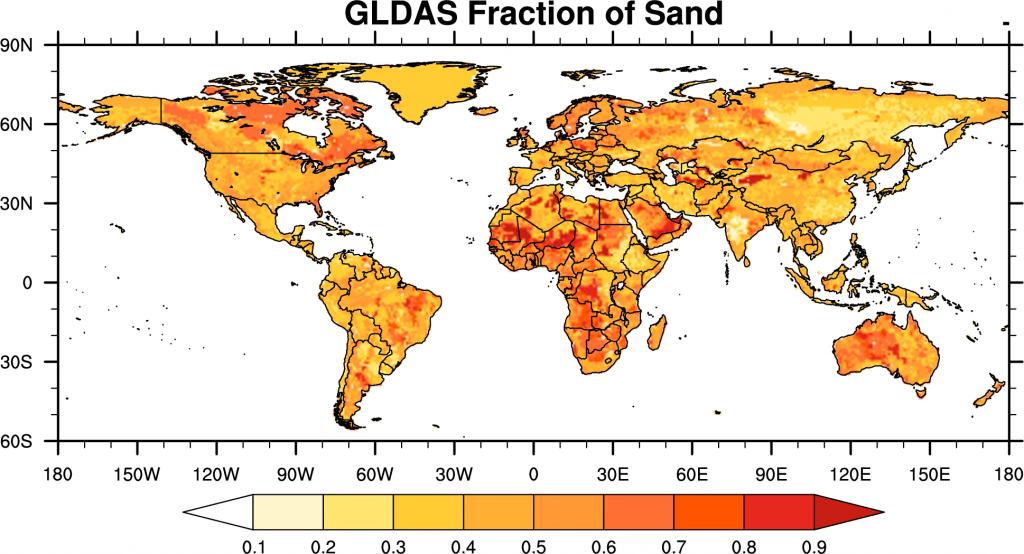
Sand isn’t just sand. Its composition changes dramatically by location, reflecting local geology, climate, and biology. Under magnification, each beach tells a different story.
Hawaii: Volcanic and Biogenic Wonders
Hawaii’s sands are born from fire and sea. At Papakōlea Beach, the rare green sand glows under the lens due to olivine crystals—a mineral from deep within Earth’s mantle, brought to the surface by volcanic eruptions. Wave action over centuries has washed away lighter minerals, leaving behind this dense green treasure.
Punalu’u Beach offers stark black sand composed of basalt fragments and volcanic glass, formed when lava meets seawater in explosive cooling. Under 100x magnification, these grains appear jagged, glassy, and sometimes vesicular—like frozen bubbles.
On Maui, the sand is a blend of coral shards, foraminifera, quartz, and feldspar. Some grains resemble tiny stars or honeycombs—evidence of marine life breakdown. These biogenic fragments stand out in contrast to angular volcanic pieces, creating a mosaic of organic and inorganic origins.
Bahamas: Pure Carbonate Beaches
The Bahamas boast some of the purest white sands on Earth—nearly 99% calcium carbonate from coral and shell debris. Under the microscope, grains appear translucent, dome-shaped, and smooth, like tiny pearls. Their uniformity reflects long wave polishing in warm, shallow waters.
Unlike mineral sands, these grains dissolve slightly in acidic conditions, leaving behind etching pits and dissolution marks—clues to their biological origin and environmental sensitivity.
Australia: Red Deserts and White Coasts
Australia’s red desert sands get their hue from iron oxide (hematite) that coats each quartz grain over millennia of chemical weathering. These well-rounded grains show signs of wind transport—frosted surfaces with microscopic pitting from constant abrasion.
In contrast, coastal white sands are almost pure quartz (SiO₂), ground down from ancient continental rocks. Under the lens, they sparkle like sugar—bright, clear, and often perfectly rounded from endless wave tumbling.
Namibia: Ancient Red Dunes
The Namib Desert holds some of Earth’s oldest dunes, where sand grains have been sculpted by wind for over 50 million years. The deep red and orange tones come from iron-bearing minerals, while surface analysis reveals frosting and pitting—micrometeorite scars and sandblasting marks from aeolian forces.
These grains are textbook examples of wind-abraded sand, with dull, scarred surfaces that differ sharply from the glassy shine of water-transported grains.
California: Mixed-Source Complexity
California’s beaches, like Newport and Malibu, feature complex mineral mixes: quartz, feldspar, mica, amphibole, and rock fragments. Colors range from pink (feldspar) to black (magnetite). Shapes vary—some angular (recent erosion), others rounded (long transport)—telling a story of tectonic activity, river runoff, and coastal dynamics.
This mineral diversity makes California sand a favorite among geology students for provenance analysis—matching grains to their source rocks in the nearby mountains.
Gulf Coast: Quartz Dominance
From Gulf Shores, AL to Fort Myers, FL, the sand is dominated by clear quartz, large and well-rounded. This gives the famous squeaky “singing sand” effect underfoot. Under magnification, the grains are remarkably uniform—evidence of prolonged water movement and sorting.
The high quartz purity suggests long transport from the Appalachian Mountains via rivers and longshore drift.
Indonesia: Pink Beaches
Komodo Island’s pink sand is a marvel of biology. The hue comes from crushed red foraminifera shells—microscopic organisms with red-pigmented calcite shells—mixed with white coral and quartz. At 100x, the tiny red specks are unmistakable, like confetti in a sea of white.
This sand is fragile; over-tourism and shell harvesting threaten its unique color.
Moon: Not Sand, But Regolith
Lunar “sand” is technically regolith—a layer of loose, fragmented material. Unlike Earth sand, it wasn’t shaped by water or wind. Instead, constant micrometeorite impacts in a vacuum have shattered rock into extremely jagged, pitted grains.
Under the microscope, lunar regolith grains show sharp edges, fused surfaces (agglutinates), and no rounding—a stark contrast to Earth’s smoother sands. They’re also electrostatically charged, making them cling to spacesuits and equipment.
What Makes Up Sand? Mineral, Biogenic, and Human Traces

Sand is defined as granular material with particles between 0.0625 mm and 2 mm. But under the microscope, its components fall into three main categories.
Mineral Grains: Nature’s Building Blocks
- Quartz (SiO₂): The most common mineral, colorless and transparent, resistant to weathering. Found in nearly all continental sands.
- Feldspar: Pink or white, less durable than quartz. Its presence suggests nearby granite sources.
- Mica (muscovite/biotite): Shiny, flaky grains that glitter under light. Easily split into thin sheets.
- Olivine: Bright green, volcanic origin. Common in Hawaii and other basaltic regions.
- Iron Oxides (hematite, magnetite): Give red, brown, or black color. Hematite coats grains; magnetite is magnetic.
Biogenic Materials: Remnants of Life
- Coral and Shell Fragments: White, porous, often angular. Break down into calcium carbonate (CaCO₃) grains.
- Foraminifera: Microscopic organisms with calcite shells. Some produce red pigments, contributing to pink sands.
- Diatoms: Silica-shelled plankton. More common in silt, but visible in fine sand fractions.
Anthropogenic Debris: Human Fingerprints
- Microplastics: Increasingly common—fibers, beads, shards from broken bottles or synthetic fabrics.
- Industrial Slag, Glass Beads, Concrete: Found in urban and construction sands.
- Heavy Metals: Not visible under optical scopes but detectable via SEM-EDS or chemical testing.
Pro Tip: When examining sand, look for synthetic fragments—perfectly round beads or uniform fibers are almost always human-made.
Grain Shape: Clues to Transport History
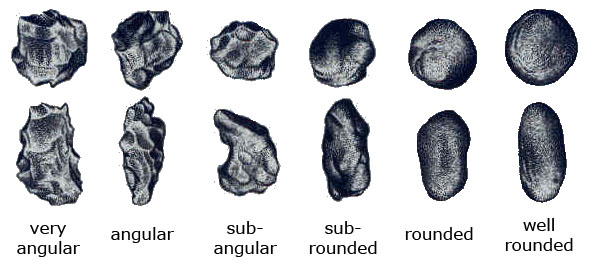
The shape of a sand grain reveals how far it’s traveled and by what force.
Angular Grains
- Sharp edges and corners.
- Indicate recent breakage and short transport.
- Common in mountain streams, glacial outwash, or near cliffs.
Example: Wrightsville Beach, NC has angular quartz grains—suggesting limited wave action and local erosion.
Sub-Angular Grains
- Edges slightly worn.
- Intermediate stage—moderate transport by water or wind.
Sub-Rounded Grains
- Moderately smoothed.
- Seen in rivers, estuaries, and mid-distance beaches.
Well-Rounded Grains
- Smooth, spherical.
- Result from long-term tumbling in water or wind.
- Typical of mature beaches (e.g., Gulf Shores) or desert dunes.
Key Insight:
– Well-rounded + glassy surface = water transport (beach/river)
– Well-rounded + frosted surface = wind transport (desert)
Surface Texture: How Environment Shapes Grains

The grain surface tells you about the energy and medium of transport.
Glassy, Reflective Surfaces
- Smooth, shiny.
- Formed in aqueous environments where water cushions collisions.
- Common in beaches and rivers.
Frosted and Pitted Surfaces
- Dull, scarred, with tiny craters.
- Caused by high-energy wind abrasion.
- Hallmark of desert sands (e.g., Sahara, Namib).
Conchoidal Fractures
- Curved, shell-like break patterns.
- Found in quartz and volcanic glass—signs of brittle fracture.
Etching and Dissolution Pits
- Pockmarks on carbonate grains.
- Caused by acidic groundwater or seawater.
Visual Cue: Use oblique lighting to enhance surface texture. Side illumination highlights pits and fractures.
Color and Transparency: Mineral ID at a Glance
Color under the microscope helps identify mineral type—fast and non-destructive.
| Color | Likely Mineral | Transparency |
|---|---|---|
| Clear/Colorless | Quartz, calcite | Transparent |
| White | Feldspar, mica | Translucent |
| Red/Brown | Hematite-coated quartz | Opaque |
| Green | Olivine, epidote | Transparent to translucent |
| Black | Magnetite, basalt, glass | Opaque |
| Pink/Orange | K-feldspar, foraminifera | Translucent |
Note: Some colors are enhanced by lighting. Darkfield illumination brings out subtle hues in transparent grains.
How to Examine Sand: Microscopy Techniques
You don’t need a lab to see sand’s secrets. With the right setup, even hobbyists can unlock its beauty.
Sample Preparation
- Wash the Sand: Shake in water, let settle, decant. Repeat until water is clear—removes salts and silt.
- Use a Wet Mount: Place a drop of water on a slide, add sand, cover. Water reduces glare and increases grain clarity.
- Permanent Mounts: For long-term storage, embed in Canada balsam or epoxy resin.
Lighting Techniques
| Technique | Best For | Effect |
|---|---|---|
| Brightfield | General viewing | Shows grain outlines |
| Darkfield | Color and transparency | Makes grains glow against dark background |
| Incident (Reflected) Light | Opaque grains | Highlights metallic minerals, glass, concrete |
| Oblique Illumination | Surface texture | Reveals pits, fractures, frosting |
| Combination Lighting | Full detail | Captures internal + external features |
Pro Tip: Use darkfield + incident light for the most dramatic images—especially with mixed sand types.
Magnification and Objectives
- 4x–10x: Best for overview and grain distribution.
- 40x–100x: Ideal for mineral ID, surface features, microfossils.
- Recommended Objectives:
- Olympus 4/0.10 (4x)
- Zeiss 3.2/0.07
- Leitz 4/0.12
- Olympus 10/0.25
Direct Projection: For DSLR or high-res cameras, use fully corrected objectives to avoid distortion.
Scientific Uses: More Than Just Pretty Pictures
Sand microscopy isn’t just for show—it’s a powerful analytical tool.
Geology & Sedimentology
- Provenance Analysis: Match mineral mix to source rock (e.g., feldspar = granite).
- Depositional Environment: Angular grains = glacial; frosted = desert; rounded = beach.
- Sedimentary Classification: Identify sandstone types (e.g., quartz arenite = pure quartz; arkose = feldspar-rich).
Environmental Monitoring
- Microplastic Detection: Count and classify synthetic particles.
- Bioindicators: Presence of foraminifera or coral fragments signals healthy reef systems.
- Pollution Tracking: Detect industrial slag, heavy metals, or construction waste.
Forensic Science
- Trace Evidence: Sand on shoes, tires, or clothes can link suspects to crime scenes.
- Geolocation: Unique mineral signatures can pinpoint where sand came from—even to a specific beach.
Education & Outreach
- STEM Engagement: Sand labs teach geology, biology, and optics.
- Citizen Science: Enthusiasts build personal sand atlases from travel samples.
- Art Inspiration: Images inspire glass art, jewelry, and digital designs.
Common Misconceptions Clarified
Myth: “All sand looks colorful under a microscope”
- Reality: Most beach sand is dominated by quartz and feldspar—colorless or white. The most vibrant images often showcase curated grains or optimized lighting.
Myth: “Sand is salty”
- Clarification: Sand grains themselves aren’t salty. Salt is dissolved sea mineral that washes off with water.
Myth: “Lunar sand is like Earth sand”
- Correction: Moon regolith is sharp, jagged, and unweathered—no water or wind to round it. It’s also electrostatically charged, making it cling to suits.
Myth: “No microplastics? Then it’s clean”
- Fact: Many microplastics are <10 μm—invisible without fluorescent staining or SEM. Their absence in optical images doesn’t mean they’re not there.
Final Note: Sand as a Planetary Storyteller
Each grain of sand is a geological time capsule. It may have started as a mountain peak, been carried by rivers, tossed by waves, or blown by desert winds. Under the microscope, you’re not just seeing sand—you’re seeing Earth’s history in miniature.
From the iron-rich red dunes of Australia to the coral-built white beaches of the Bahamas, sand reflects the dynamic forces that shape our planet. And now, with accessible tools and growing awareness, anyone can explore this hidden world.
So next time you’re at the beach, scoop up a handful. Wash it, mount it, magnify it. You might just find a tiny universe—one grain at a time.