Your drill bit shatters on the third hole. Smoke rises from the workpiece. The hole walls look torn and ragged. These common drilling disasters almost always trace back to one critical factor: improper spindle speed. Using a drill spindle speed calculator isn’t just helpful—it’s essential for professional results and tool longevity. The right rotational speed prevents overheating, extends bit life by up to 300%, and produces clean, precise holes every time. Whether you’re working with delicate aluminum or tough stainless steel, this guide shows you exactly how to determine the optimal spindle speed using proven calculations and practical reference tools.
Why Your Drill Bit Keeps Failing: The Spindle Speed Connection
Every drill bit failure tells a story about rotational speed. When your bit snaps during deep drilling, it’s not always poor technique—it’s often excessive RPM for the material hardness. High-speed steel (HSS) bits lose their temper when heated above 1,000°F, which happens in seconds at incorrect spindle speeds. The solution starts with understanding that surface speed—not just revolutions per minute—determines cutting efficiency. Your drill spindle speed calculator must account for both bit diameter and material properties to prevent these costly mistakes.
The Exact Drill Spindle Speed Formula You Need
Stop guessing with arbitrary speed settings. Use this precise formula to calculate spindle speed for any drill press or handheld drill:
RPM = (SFM × 3.82) / Bit Diameter (in inches)
This equation converts surface speed (SFM) to spindle speed (RPM) based on your specific bit size. The 3.82 constant accounts for unit conversions and pi. For example, drilling 1/4″ mild steel requires 1,528 RPM—not some arbitrary mid-range setting on your drill press dial. This calculation transforms guesswork into precision, ensuring your spindle speed matches the material’s requirements.
Material-Specific SFM Values: Your Drill Speed Calculator Foundation
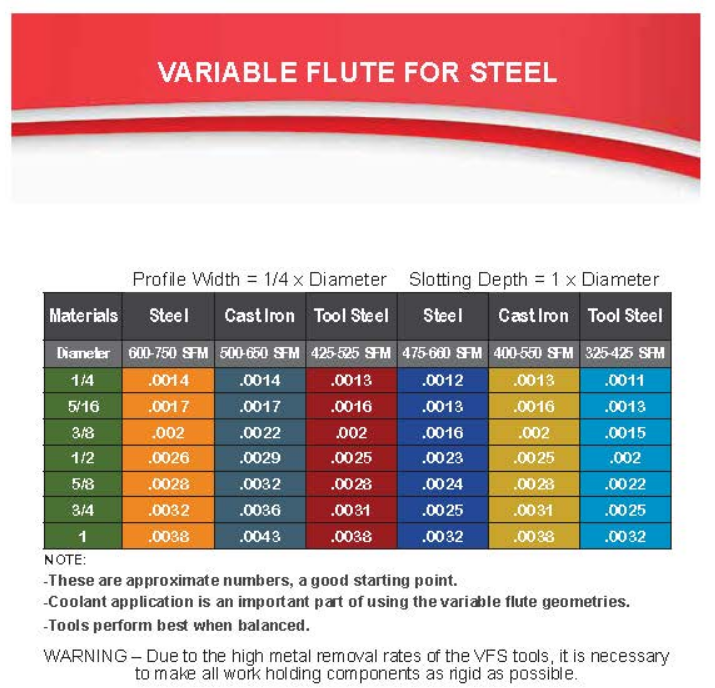
The secret to accurate spindle speed calculation lies in selecting the correct Surface Feet per Minute (SFM) value. SFM represents how fast the bit’s cutting edge travels through the material. Different materials demand radically different SFM values, and using the wrong one causes immediate problems. Your drill spindle speed calculator is only as good as the SFM input you provide.
Aluminum vs. Stainless: Why One Speed Doesn’t Fit All
| Material | Recommended Bit Type | Safe SFM Range (HSS) | Critical Warning |
|---|---|---|---|
| Aluminum | HSS, Cobalt | 200-300 | Too slow causes galling; too fast melts soft metal |
| Mild Steel | HSS, Cobalt | 80-120 | Exceeding 120 SFM dulls bits rapidly in 1018 steel |
| Stainless Steel | Cobalt, Carbide | 30-70 | Below 30 SFM causes work hardening in 304 stainless |
| Cast Iron | HSS, Cobalt | 50-100 | Requires peck drilling to prevent chip packing |
| Brass/Bronze | HSS | 150-250 | High speeds cause grabbing; use sharp bits only |
| Acrylic | Brad Point | 100-200 | Excessive heat melts plastic; reduce speed by 25% |
This table serves as your primary input for any drill spindle speed calculator. Notice how stainless steel requires less than half the SFM of aluminum? This explains why the same RPM setting that works perfectly for aluminum will destroy a bit in stainless steel. Always verify your material type—many beginners mistake 303 stainless for mild steel with disastrous results.
How to Calculate Drill Spindle Speed in 3 Simple Steps
Forget complicated charts—follow this streamlined process for immediate results. Your drill spindle speed calculator needs only three inputs, but getting them right makes all the difference.
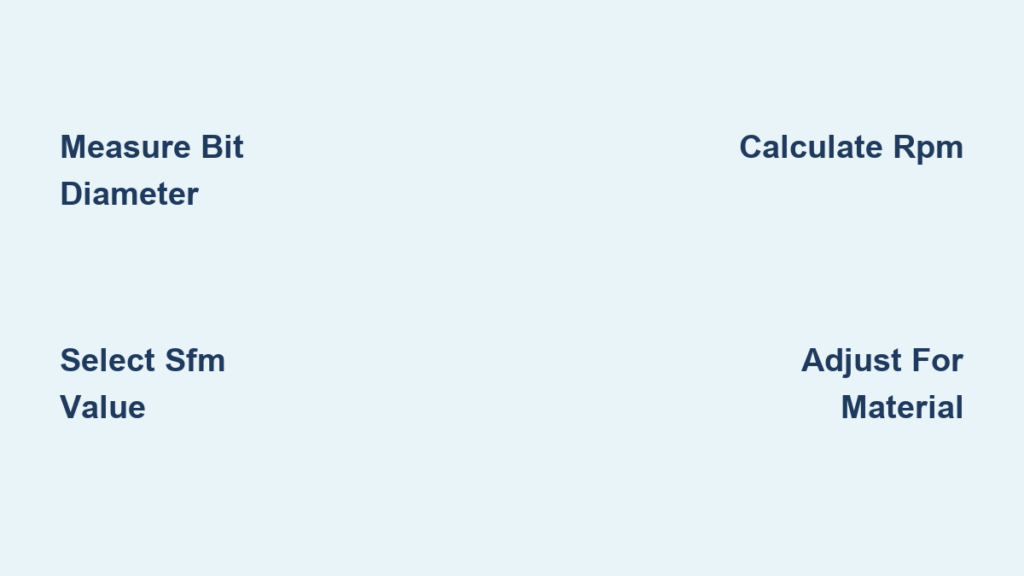
Step 1: Measure Your Exact Bit Diameter
Grab your digital calipers—don’t rely on nominal sizes. A “1/4 inch” bit might actually measure 0.248″. This 0.002″ difference changes your calculated RPM by over 30! For metric bits, convert to inches (6mm = 0.236″) before calculation. Precision here prevents cumulative errors that compound with each drilling operation.
Step 2: Select the Correct SFM Value
Cross-reference your material with the table above. When working with unknown metals, start at the lower SFM range (e.g., 80 for steel) and adjust upward. For hardened materials or tight tolerances, reduce SFM by 20%. Remember: it’s easier to increase speed than to replace a burned-out bit.
Step 3: Perform the Calculation (With Real Example)
Let’s calculate spindle speed for a 5/16″ (0.3125″) cobalt bit drilling 304 stainless steel:
– SFM = 50 (mid-range for stainless)
– Diameter = 0.3125″
– RPM = (50 × 3.82) / 0.3125 = 611 RPM
Set your drill press to 600 RPM—never round up when drilling hard materials. This precise calculation prevents the blue discoloration that signals bit temper loss.
Why Your Drill Smoke Signals: Overheating and Speed Mistakes
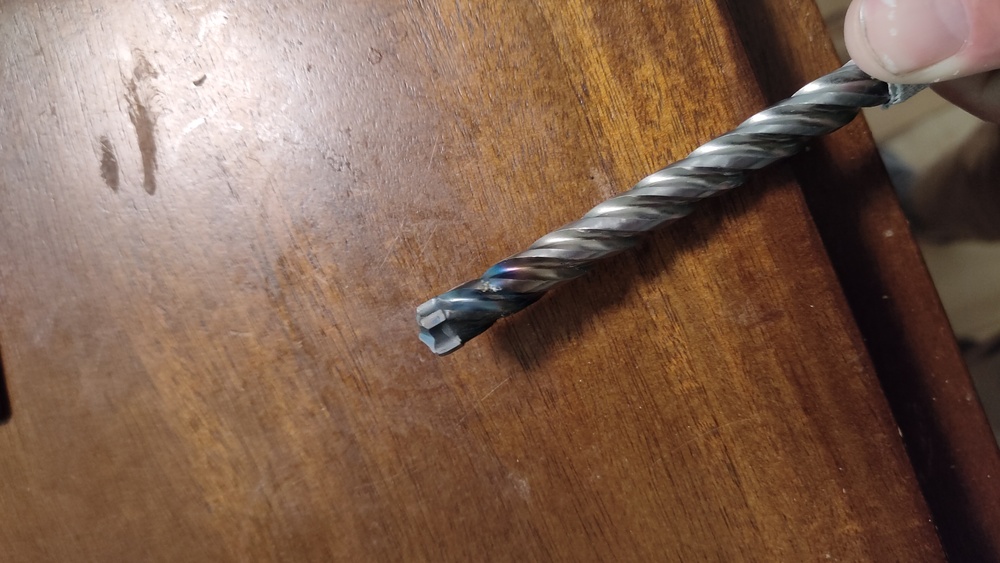
That acrid smell during drilling? It’s your bit losing hardness at 1,000°F. Most drill failures occur because users ignore these critical warning signs:
- Blue/purple bit discoloration: Immediate sign of overheating—stop drilling
- Chattering vibration: Usually means RPM is too low for the feed rate
- Poor chip formation: Instead of spiral chips, you get powder (too slow) or fine dust (too fast)
- Workpiece burning: Particularly in wood or plastics, indicating excessive speed
Your drill spindle speed calculator must account for these visual cues. If you see any warning signs, reduce RPM by 15-20% before continuing. For deep holes exceeding 3x bit diameter, cut speed by another 25% to compensate for reduced heat dissipation.
Drill Bit Survival Guide: Lubrication and Material Considerations
Speed alone won’t save your bits—lubrication is equally critical. Most beginners skip this step, then wonder why their bits fail prematurely. Here’s what you need to know:
- Metals: Use sulfurized cutting oil for steel, light oil for aluminum. Never use WD-40 as primary lubricant—it evaporates too quickly
- Stainless Steel: Requires constant flood coolant; intermittent application causes thermal shock
- Cast Iron: Often drilled dry, but use light oil for deep holes to prevent chip packing
- Plastics: Reduce speed by 25% and use air blast instead of liquid coolant
For every 25°F increase in cutting temperature, tool life decreases by 50%. Proper lubrication keeps temperatures in the safe zone, effectively doubling your bit’s lifespan. Always apply lubricant directly to the cutting edge—not just the workpiece surface.
Pro Techniques: Peck Drilling and Feed Rate Optimization
Spindle speed is only half the equation—your feed rate determines chip thickness and heat generation. Most drill presses lack feed rate controls, so you must develop the right hand pressure.
The Feed Rate Sweet Spot
Push too hard and you’ll break the bit; too light causes rubbing that dulls the cutting edge. For a 1/4″ bit in steel, aim for 3 inches per minute feed rate. This creates optimal 0.002″ chip thickness. You’ll know you’ve hit the sweet spot when chips flow freely as tight spirals—not powdery debris.
Master Deep Hole Drilling with Peck Cycles
For holes deeper than 3x bit diameter:
1. Drill to depth = 1x bit diameter
2. Fully retract to clear chips
3. Apply fresh lubricant
4. Repeat, reducing depth by 25% each cycle
This technique prevents chip packing that causes bit breakage in stainless steel and cast iron. It adds time but saves costly tool replacements.
Drill Speed Calculator Quick Reference for Common Sizes
Keep this chart near your drill press for instant reference. All values assume 100 SFM for mild steel—adjust downward for harder materials.
| Bit Size | Required Spindle Speed | Stainless Steel Adjustment |
|---|---|---|
| 1/8″ | 3,056 RPM | 1,500-2,100 RPM |
| 1/4″ | 1,528 RPM | 750-1,050 RPM |
| 3/8″ | 1,018 RPM | 500-700 RPM |
| 1/2″ | 764 RPM | 380-530 RPM |
| 3/4″ | 509 RPM | 250-350 RPM |
Critical note: For bits larger than 1/2″, reduce calculated RPM by 20% to prevent excessive torque on your drill press. Large bits generate tremendous cutting forces—even at correct SFM.
Final Drill Speed Checklist Before You Begin
Before firing up your drill press, verify these five critical factors:
- Material verification: Confirm whether you’re drilling 303 stainless (needs 50 SFM) or mild steel (100 SFM)
- Bit condition: Replace any bit with visible wear on cutting edges
- Lubrication ready: Have appropriate coolant within immediate reach
- Workpiece secure: Clamp firmly to prevent spinning or grabbing
- Speed double-checked: Recalculate using your drill spindle speed calculator
Start 10-15% below calculated RPM, then gradually increase while monitoring chip formation. The perfect speed produces consistent spiral chips without discoloration or excessive noise. Remember: when in doubt, slow down. It’s always better to take more time than to replace a broken bit and damaged workpiece.
By mastering these spindle speed principles, you’ll transform from guessing to precision drilling. Your drill spindle speed calculator becomes more than a tool—it’s your key to professional results on every project. Keep this guide handy, and you’ll never waste another bit to incorrect speed settings.