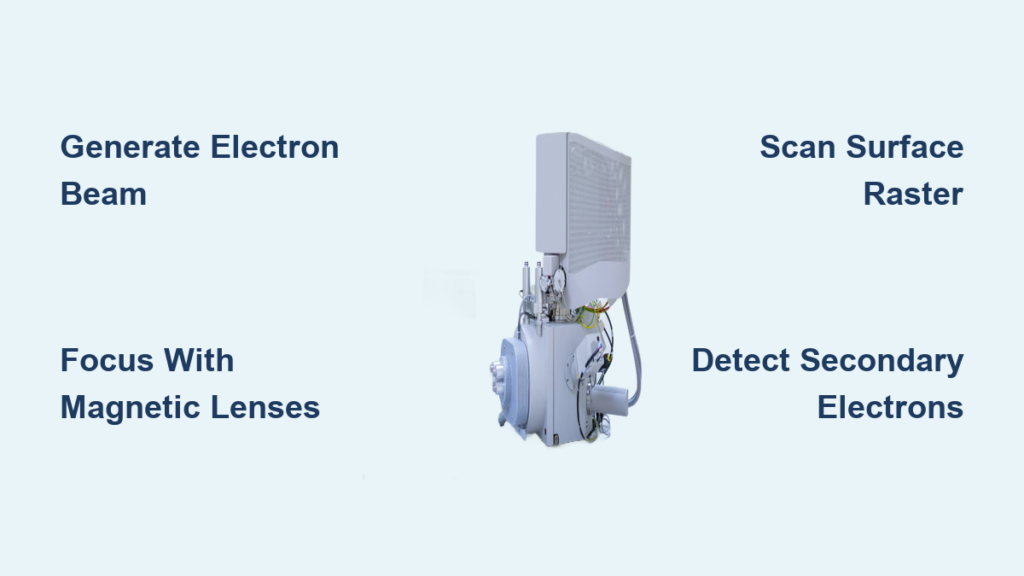
If you’ve ever seen a strikingly detailed image of a butterfly’s wing, a microchip’s circuitry, or a cracked metal surface—sharp, three-dimensional, and magnified hundreds of thousands of times—you’ve likely witnessed the power of a scanning electron microscope (SEM). Unlike optical microscopes that rely on visible light, SEMs use a focused beam of electrons to scan the surface of a sample, revealing features as small as 0.4 nanometers—over half a million times smaller than the width of a human hair.
So, how does a scanning electron microscope work? At its core, an SEM generates high-resolution images by directing a beam of electrons across a sample, detecting the signals produced when those electrons interact with atoms, and converting that data into a magnified, detailed image. This process allows scientists to visualize not just surface topography, but also elemental composition, crystal structure, and even electronic properties with extraordinary clarity.
In this guide, you’ll learn how each component of the SEM functions, how electron-sample interactions generate different types of data, and how modern advancements like environmental SEM and 3D reconstruction expand its capabilities. Whether you’re in materials science, biology, forensics, or engineering, understanding SEM operation unlocks deeper insights into the microscopic world.
Generate the Electron Beam with Precision
Choose the Right Electron Source
The journey begins at the top of the microscope column, where the electron gun emits a stream of electrons. The type of emitter used directly affects resolution, brightness, and stability. There are three primary types:
- Tungsten filament: Heated to over 2,000°C, releasing electrons via thermionic emission. It’s affordable but offers lower brightness and a short lifespan (~50–100 hours).
- Lanthanum hexaboride (LaB₆): Provides higher brightness and longer life than tungsten, though it requires a better vacuum system.
- Field emission gun (FEG): Uses a sharp tungsten tip where a strong electric field extracts electrons. Two variants exist:
- Cold FEG: Operates at room temperature; delivers ultra-high resolution but is sensitive to contamination.
- Schottky FEG: Combines heat and electric field for stable, high-current emission.
FEG sources produce the highest resolution (down to 0.4 nm) and enable low-voltage imaging—critical for delicate or non-conductive samples like polymers or biological tissues.
Accelerate and Shape the Electron Beam
After emission, electrons are accelerated toward a positively charged anode, typically at voltages between 0.1 kV and 30 kV. Higher voltages increase penetration depth but may damage sensitive materials.
Beam current and diameter are controlled by the Wehnelt bias and first anode geometry, shaping the initial electron stream before it enters the lens system. This ensures a well-defined beam enters the next stage: focusing.
Focus the Beam Using Electromagnetic Lenses

Use Magnetic Fields Instead of Glass
Since electrons cannot be focused by glass lenses, SEMs use electromagnetic lenses—coils surrounded by iron pole pieces that generate magnetic fields to bend electron trajectories.
Key lenses include:
- Condenser lens(es): Regulate beam intensity and convergence angle by adjusting current, controlling how much of the beam reaches the sample.
- Objective lens: The final focusing element that concentrates the beam into a fine spot on the sample surface.
Apertures—metal discs with tiny holes—are placed along the column to limit beam spread and reduce optical aberrations.
Minimize Aberrations for Sharper Imaging
Even with precise focusing, spherical and chromatic aberrations can blur the electron probe. Modern SEMs combat these through:
– Aperture selection: Smaller apertures reduce divergence but lower signal strength.
– Stigmators: Correct astigmatism by fine-tuning the symmetry of the magnetic field.
– Beam deceleration: In low-voltage mode, the sample is negatively biased to slow electrons just before impact, improving surface resolution.
These adjustments ensure the smallest possible probe size, essential for high-magnification imaging.
Scan the Sample Surface in a Raster Pattern
Deflect the Beam with Scanning Coils
Once focused, the electron beam is steered across the sample using scanning coils located near the objective lens. These electromagnetic or electrostatic coils deflect the beam in a precise raster pattern—left to right, line by line—just like an old CRT television.
This scanning motion is synchronized with the display, so each position of the beam corresponds exactly to a pixel on the screen.
Control Magnification Electronically
Unlike optical systems, SEM magnification doesn’t depend on lens power. Instead, it’s determined by the ratio between:
– The size of the area scanned on the sample.
– The fixed size of the display screen.
For example:
– Scanning a 1 mm area → 10x magnification.
– Scanning a 1 μm area → 100,000x magnification.
By reducing the scan area while keeping the output size constant, magnification increases smoothly—from 10x to over 1,000,000x—all controlled electronically via scanning coil current.
Detect Signals from Electron-Sample Interactions

When the electron beam strikes the sample, it interacts with atoms within a teardrop-shaped volume beneath the surface, generating multiple detectable signals. The type and strength of these signals depend on beam energy, sample composition, and density.
Capture Secondary Electrons for Surface Topography
Secondary electrons (SE) are low-energy electrons (5–50 eV) ejected from the outer shells of atoms due to inelastic scattering.
- Escape depth: Only from the top 5–10 nm of the surface.
- Detected by: Everhart–Thornley detector, which uses:
- A positively biased grid (+300 to +400 V) to attract SEs.
- A scintillator (+2–10 kV) to convert electrons into photons.
- A photomultiplier tube to amplify the signal.
SEs are highly sensitive to surface contours. Edges and protrusions emit more electrons, appearing brighter, giving images a 3D-like appearance. This makes SE imaging ideal for examining fine surface details—like insect eyes, nanoparticles, or fracture surfaces.
Identify Composition with Backscattered Electrons
Backscattered electrons (BSE) are primary beam electrons reflected after elastic collisions with atomic nuclei.
- Energy: High (close to beam energy).
- Escape depth: Up to hundreds of nanometers.
- Detected by: Solid-state semiconductor detectors, often arranged in a doughnut shape around the beam.
BSE yield increases with atomic number (Z)—heavier elements appear brighter. This Z-contrast allows clear differentiation between phases in alloys, minerals, or composites.
Segmented BSE detectors also provide directional shading, enhancing topographic interpretation without tilting the sample.
Analyze Elements Using Characteristic X-rays
When a primary electron knocks out an inner-shell electron from a sample atom, an outer-shell electron fills the gap, releasing energy as an X-ray photon with a wavelength unique to that element.
- Detected by:
- EDS (Energy-Dispersive X-ray Spectroscopy): Fast, simultaneous detection of all elements (typically B to U).
- WDS (Wavelength-Dispersive X-ray Spectroscopy): Higher spectral resolution for precise quantification.
These techniques enable:
– Elemental identification at specific points.
– Elemental mapping across the surface.
– Quantitative analysis of composition.
Non-conductive samples are often carbon-coated during EDS to prevent charging, though ESEM allows uncoated analysis.
Map Crystal Structure with EBSD
Electron Backscatter Diffraction (EBSD) captures Kikuchi patterns formed by diffracted backscattered electrons.
- Requires a tilted sample (70°) and high vacuum.
- Software analyzes pattern symmetry to determine:
- Crystal orientation.
- Grain boundaries.
- Phase distribution.
Used extensively in metallurgy and geology, EBSD enables microstructure-property correlation, such as linking grain size to material strength.
Maintain High Vacuum or Enable Wet Samples with ESEM
Prevent Electron Scattering and Filament Damage
The entire electron column must operate under high vacuum (10⁻³ to 10⁻⁶ Pa) to:
– Prevent electrons from colliding with air molecules.
– Avoid oxidation and burnout of the hot filament.
– Ensure efficient signal detection.
Poor vacuum leads to:
– Blurry images.
– Unstable beam.
– Shortened filament life.
Enable Imaging of Wet or Insulating Samples with ESEM
Environmental SEM (ESEM) uses differential pumping to maintain high vacuum in the gun while allowing higher pressure (1–50 Torr) near the sample.
- Water vapor or other gases neutralize charge on insulating samples.
- Enables imaging of:
- Hydrated biological tissues.
- Polymers.
- Living insects (in controlled conditions).
ESEM uses a gaseous secondary electron detector (GSED), where gas molecules amplify the SE signal through ionization cascades.
First commercialized in 1988, ESEM has revolutionized imaging of natural, uncoated, and dynamic samples.
Prepare Samples to Prevent Charging and Artifacts
Handle Conductivity Issues in Non-Conductive Materials
Non-conductive samples (e.g., plastics, ceramics, biologicals) accumulate negative charge under electron bombardment, causing:
– Image streaking.
– Brightness fluctuations.
– Sudden discharges (“charging glow”).
Solutions include:
Apply Conductive Coatings
- Sputter coating with gold, platinum, or carbon (5–20 nm thick).
- Enhances secondary electron yield and provides grounding path.
- Common for biological and polymeric samples.
Use Bulk Staining
- OTO staining (Osmium Tetroxide–Thiocarbohydrazide–Osmium) impregnates biological samples with heavy metals, increasing bulk conductivity without surface coating.
Operate at Low Voltage
- FEG-SEMs can run at 0.3–4 kV, balancing incoming and outgoing electron currents to minimize charging.
- Allows imaging of uncoated paper, polymers, and delicate nanostructures.
Build Images Pixel by Pixel and Enhance with Color
Generate Images Through Sequential Scanning
SEM images are formed sequentially, not all at once like a camera. As the beam scans each point (pixel), the detector records signal intensity, which is synchronized with beam position.
Each intensity value becomes a grayscale pixel on the display:
– High signal → bright pixel.
– Low signal → dark pixel.
Scan speed affects image quality:
– Fast scans: Lower resolution, real-time viewing.
– Slow scans: Higher signal-to-noise, sharper images.
Add False Color for Scientific Clarity
Raw SEM images are monochrome, but color can be added post-acquisition for scientific or visual enhancement:
- False coloring: Assign colors to grayscale levels for contrast (e.g., different phases in BSE images).
- Multi-detector coloring (DDC-SEM):
- SE → green (topography).
- BSE → red (composition).
- Combined → color image showing both shape and material contrast.
- Analytical overlays: EDS maps or EBSD data merged as color layers onto SE images.
Note: Color in SEM is artificial—it conveys information but does not represent true color.
Reconstruct 3D Surface Topography from 2D Data

Create 3D Models Using Multiple Techniques
While SEM produces 2D images, several methods generate 3D reconstructions:
Use Stereoscopic Imaging
- Acquire two images at ±5°–10° tilt.
- Software calculates height differences using disparity mapping (triangulation).
- Most accurate method; requires a tilt stage.
Used in metrology and failure analysis.
Apply Shape-from-Shading
- Use multi-segment BSE detectors (e.g., 4-quadrant) to capture angular signal variation.
- Brighter signals indicate surfaces facing the detector.
- Software integrates slope data into a real-time 3D topographic map.
No sample tilt needed—available as a built-in feature in many SEMs.
Perform Ion-Abrasion Tomography
- Combine SEM with focused gallium ion beam (FIB).
- Mill away layers (~20 nm thick) sequentially.
- Image each newly exposed surface.
- Stack images to build a 3D nanotomography dataset.
Used for studying cellular ultrastructure, battery materials, and semiconductor defects.
Apply SEM Across Scientific Fields
Study Materials Failure and Microstructure
In materials science, SEM is essential for:
– Fractography: Analyze fracture surfaces to determine failure mode (ductile, brittle, fatigue).
– Particle analysis: Measure size, shape, and distribution.
– Coating evaluation: Assess thickness, adhesion, and porosity.
– In situ testing: Observe deformation or heating with specialized stages.
Combined with EBSD and EDS, SEM links microstructure to mechanical behavior.
Image Biological Specimens in Detail
In life sciences, SEM reveals:
– Cellular and subcellular structures (e.g., cilia, mitochondria).
– Bacteria, viruses, pollen, and diatoms.
– Immuno-gold labeling for protein localization.
Cryo-SEM preserves hydrated samples by rapid freezing (vitrification), avoiding ice crystals. Often combined with freeze-fracturing to expose internal membranes.
Inspect Semiconductors and Nanodevices
In the semiconductor industry, SEM enables:
– Defect inspection on 300 mm wafers.
– Circuit editing and failure analysis.
– Integration with FIB-SEM for cross-sectional imaging.
Advanced techniques include:
– EBIC (Electron Beam Induced Current): Maps p-n junctions and defects.
– Cathodoluminescence (CL): Studies light emission in LEDs and solar cells.
Support Forensic Investigations
In forensics, SEM provides non-destructive, high-magnification analysis:
– Gunshot residue (GSR) analysis: Identify Pb, Ba, Sb particles to confirm firearm discharge.
– Diatom testing in drowning cases: Match diatoms in lungs to water sources.
– Fiber and particle comparison: Link suspects to crime scenes.
Evidence remains intact after analysis.
Analyze Geological and Mineral Samples
In geology, SEM helps:
– Identify mineral phases via BSE and EDS.
– Map porosity and pore networks in rocks.
– Study fluid inclusions and ore formation.
Automated mineralogy systems (e.g., QEMSCAN) use SEM-EDS for rapid, quantitative analysis of drill cores.
Final Note: The scanning electron microscope works by scanning a focused electron beam across a sample, detecting emitted signals, and converting them into high-resolution images and analytical data. From electron generation to 3D reconstruction, every step is engineered for precision. Whether you’re analyzing a fractured alloy, mapping elemental distributions, or imaging a virus, SEM combines nanoscale resolution with multi-modal analysis—making it one of the most powerful tools in modern science. With ongoing advances in detectors, software, and correlative microscopy, the capabilities of SEM continue to expand into new frontiers.