You’re staring at a book, but the words keep swimming on the page. After just 20 minutes of screen work, your head pounds near your temples. Driving at night feels disorienting as streetlights blur into halos. If this sounds familiar, you’re likely experiencing binocular vision issues—a breakdown in how your eyes coordinate as a team. This isn’t ordinary eye fatigue; it’s a neurological disconnect where your brain struggles to merge input from both eyes into a single clear image. Left untreated, these issues sabotage reading, screen work, and even simple tasks like pouring coffee. In this guide, you’ll discover exactly how to identify your specific binocular vision dysfunction, understand why standard eye exams often miss it, and implement proven solutions that deliver real relief.
Binocular vision issues affect millions yet remain widely misunderstood. Most sufferers endure years of misdiagnosis, told they need “just better glasses” or that symptoms are “all in their head.” The truth? These problems stem from precise mechanical failures in eye teaming that require targeted intervention. Whether you’re a student struggling with textbooks, an office worker battling screen fatigue, or a driver losing confidence on the road, this article cuts through the confusion. You’ll learn to recognize the 7 hidden warning signs, understand what triggers your specific condition, and access the specialized treatments that actually rewire your visual system—not just mask symptoms.
Why Your Two Eyes Must Work as One Team
Your vision isn’t just about sharpness—it’s about precision teamwork. When functioning correctly, your eyes operate like synchronized cameras, each capturing a slightly different angle. Your brain instantly fuses these perspectives into a single 3D image, allowing you to judge distances when catching a ball or threading a needle. This binocular vision relies on six tiny muscles per eye moving in perfect harmony, guided by complex neurological pathways. The moment this coordination fails—whether by 0.5 millimeters or 5 degrees—your brain receives conflicting signals. Instead of seamless depth perception, you experience double vision, headaches, or an exhausting feeling that your eyes are “at war” with each other. This isn’t a refractive error correctable with standard glasses; it’s a teaming breakdown demanding specialized solutions.
How Brain-Eye Miscommunication Creates Double Vision
When your eyes fail to align on the same target, your brain receives two distinct images it can’t merge. This diplopia (double vision) isn’t always dramatic—you might see faint “ghosting” around text or overlapping images only when tired. Crucially, your visual system compensates by overworking certain muscles, causing the eye strain that plagues readers and screen users. Think of it like driving with one foot on the brake and one on the gas: your eyes constantly fight to maintain single vision, draining mental energy. This explains why symptoms worsen during prolonged focus tasks—the neurological demand exceeds your system’s capacity.
7 Warning Signs Your Binocular Vision Is Failing
Don’t dismiss these symptoms as normal fatigue. Binocular vision issues manifest through specific, measurable disruptions that impact daily function. Recognizing these red flags helps you advocate for proper care:
- Words swim or move on the page during reading, forcing you to reread lines
- Persistent headaches starting behind the eyes after 20+ minutes of screen use
- Difficulty catching balls or judging distances on stairs (key depth perception failure)
- Double vision when tired, especially noticeable with digital screens
- Motion sickness in busy visual environments like grocery stores
- Avoidance of near work (e.g., children refusing homework)
- Eyestrain so severe you feel pressure behind your eyeballs
Why These Symptoms Get Misdiagnosed
Standard eye exams focus on acuity (20/20 vision) and refractive errors, not eye teaming. A patient with perfect 20/20 vision can still have severe binocular dysfunction. Doctors often label symptoms as “digital eye strain” or “migraines,” missing the root cause. If your headaches persist despite blue-light glasses or your child struggles with reading despite “perfect vision,” demand a binocular vision assessment. This requires specialized tests measuring how your eyes turn inward for near work and outward for distance—capabilities most routine exams ignore.
Convergence Insufficiency: The Reading and Screen Strain Culprit
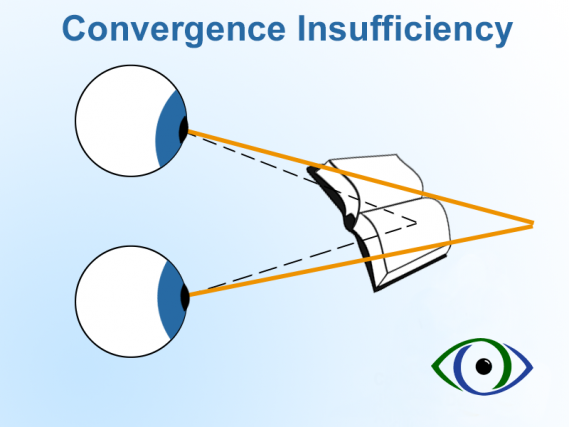
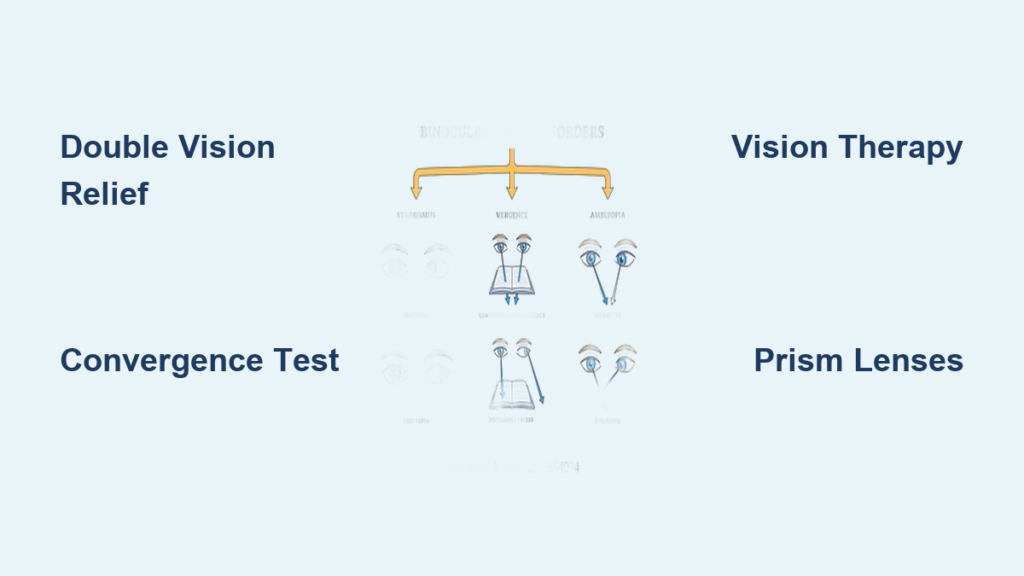
When your eyes can’t turn inward sufficiently to focus on near objects, you’re dealing with convergence insufficiency (CI)—the most common binocular vision disorder. This isn’t laziness; it’s a measurable inability to maintain proper eye alignment within 16 inches. Picture trying to thread a needle while your eyes keep drifting outward. Text appears to float, jump, or duplicate, especially during extended reading. Students with CI often skip words or lines, while office workers experience productivity crashes after short screen sessions. The strain triggers headaches centered around the temples or bridge of the nose. Crucially, CI symptoms worsen as the day progresses—your eye muscles fatigue from constant overcompensation.
How to Self-Test for Convergence Problems
Hold your finger 6 inches from your nose. Focus on your fingertip while slowly moving it toward your brow. If your vision blurs or you see double before your finger reaches 3-4 inches from your face, you likely have convergence issues. Most adults maintain single vision until 2-3 inches; children until 3-4 inches. If double vision occurs earlier, document this distance—it’s critical data for your eye specialist.
Divergence Insufficiency: Why Distance Vision Gives You Strain
While convergence issues plague near work, divergence insufficiency sabotages your distance vision. Here, your eyes struggle to stay outwardly aligned when viewing distant objects—like a car drifting left on the highway. This causes headaches during driving, difficulty tracking moving objects (like a tennis ball), and blurred vision when shifting focus from dashboard to road. Unlike convergence problems, symptoms often appear immediately upon distance viewing. You might feel “off-balance” watching movies in theaters or experience double vision when looking at whiteboards in classrooms. This condition is frequently triggered by head injuries or neurological events affecting the brain’s ability to control outward eye positioning.
The Driving Danger You’re Ignoring
Divergence insufficiency creates a subtle but dangerous visual distortion: objects appear closer than they are. At 60 mph, misjudging a car’s distance by even 10 feet could mean the difference between stopping safely and a collision. If you’ve developed new driving anxiety or notice “swimming” lane markings, get tested immediately—this isn’t normal aging.
Vision Therapy: The Gold-Standard Treatment for Binocular Vision Issues
Forget “eye exercises” you find online. Professional vision therapy is a structured neurorehabilitation program that rewires how your brain processes visual input. Under an optometrist’s supervision, you’ll perform progressive activities using specialized equipment like prism lenses, computerized tracking systems, and vectograms (3D image viewers). Sessions typically last 45-60 minutes weekly, supplemented by 15-minute daily home exercises. The goal? Retrain your visual system to maintain alignment effortlessly. Most patients see significant improvement in 12-20 weeks. Unlike glasses that mask symptoms, vision therapy builds lasting neural pathways—studies show 78% of convergence insufficiency patients achieve normal function after therapy.
What a Vision Therapy Session Actually Looks Like
You’ll start with Brock string exercises: focusing on beads along a string to develop depth perception awareness. Next, you might use a Marsden ball—tracking a moving target while maintaining single vision. Advanced stages involve virtual reality systems that simulate real-world challenges like catching virtual balls. Each activity targets specific deficiencies measured during your initial exam. Consistency is key: skipping home exercises delays progress by weeks. Your therapist adjusts difficulty weekly based on your muscle fatigue thresholds and alignment accuracy.
Prism Lenses: Your Immediate Double Vision Solution

Prism lenses bend light before it enters your eye, effectively shifting images to match your eyes’ misalignment. Unlike standard prescriptions, prism requires millimeter-precise measurements of your eye turn direction and magnitude. A common starting point is 1-2 prism diopters base-in for convergence insufficiency, reducing the effort needed to focus inward. You’ll notice effects instantly: text stabilizes, headaches diminish within hours. Crucially, prism isn’t a cure—it’s a neurological crutch allowing your visual system to rest while undergoing vision therapy. Many patients use temporary prism during therapy, then transition to prism-free glasses as their eye teaming improves.
Why Your Standard Eye Doctor Might Not Prescribe Prism
Prism requires specialized testing most general optometrists don’t perform. If your doctor dismisses prism as “unnecessary,” seek a specialist certified in binocular vision (look for FCOVD or COVD credentials). Improperly prescribed prism worsens symptoms—always verify measurements using a Risley prism during your exam, not just estimated values.
4 Daily Habits to Reduce Binocular Vision Strain at Home
You can’t out-therapy chronic strain without modifying your environment. Implement these evidence-based adjustments immediately:
- The 15-15-30 rule: Every 15 minutes of near work, look at something 15 feet away for 30 seconds (more effective than 20-20-20 for binocular issues)
- Lower screen height: Position monitors at chin level so you look slightly downward—reduces strain on convergence muscles
- Use paper weights: Anchor reading material to prevent subtle page movement that triggers double vision
- Apply blue-light filters ONLY to 50% intensity—complete blue-blockers worsen accommodation issues
Critical Lighting Adjustments Most Miss
Overhead fluorescent lights create visual noise that overwhelms strained binocular systems. Replace with adjustable LED desk lamps (3000K warmth) positioned to your non-dominant side. For nighttime driving, use anti-glare coatings with yellow tint—not clear coatings—to reduce halos around headlights.
When Surgery Becomes Necessary for Strabismus
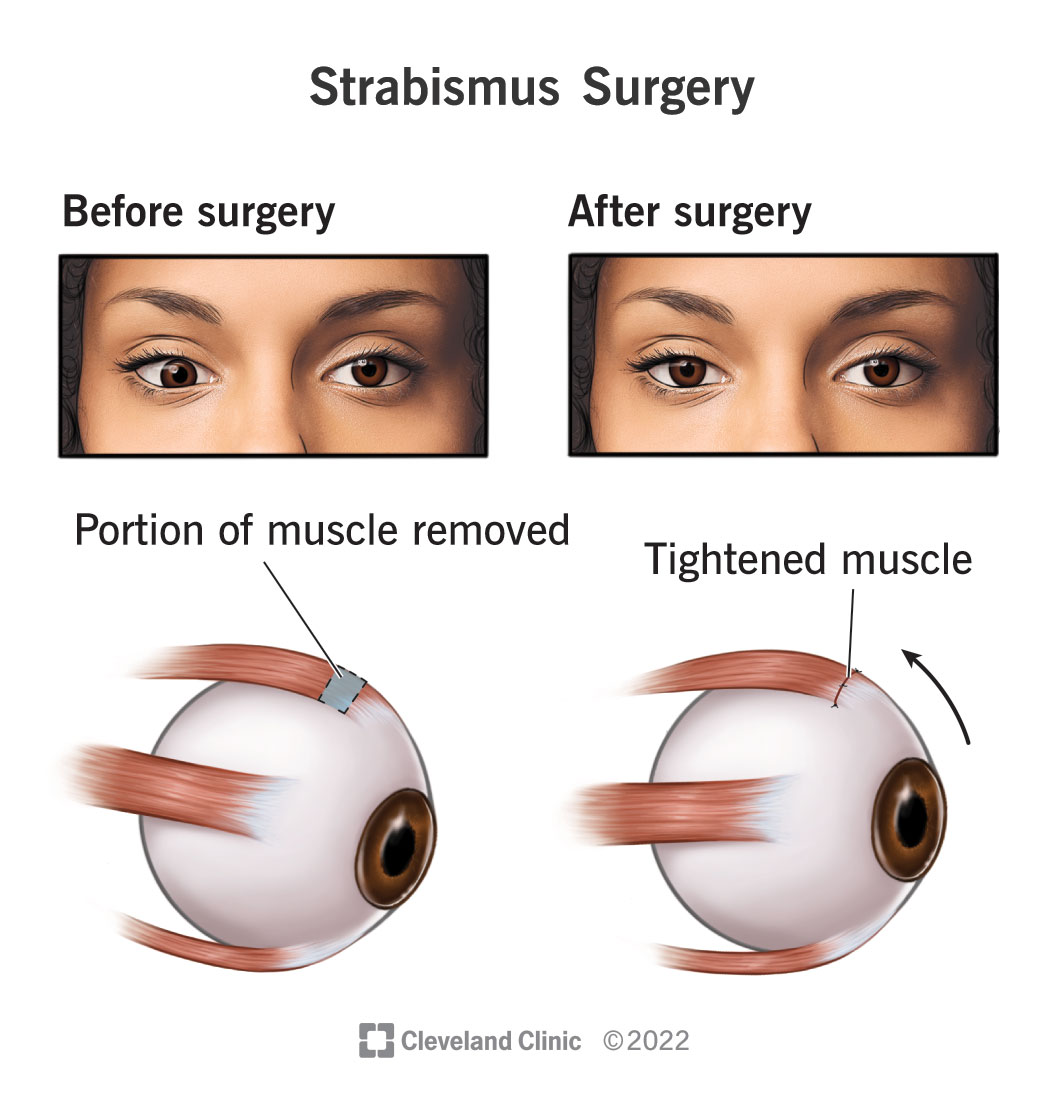
Surgery corrects physically misaligned eyes (strabismus) by adjusting eye muscle tension. It’s considered only after 6+ months of vision therapy fails to achieve functional alignment. The procedure repositions muscles to reduce the angle of misalignment—typically 50-70% correction in one surgery. Crucially, surgery addresses appearance and gross misalignment but rarely restores perfect binocular function. Post-surgery vision therapy remains essential to teach the brain to use the newly aligned eyes together. Recovery takes 4-6 weeks with temporary double vision as your visual system adapts. Success depends on realistic expectations: surgery enables potential for binocular vision, but doesn’t guarantee it.
The Essential Pre-Surgery Checklist
Before consenting, verify your surgeon:
– Performs adjustable sutures (allows fine-tuning during recovery)
– Collaborates with a vision therapist for pre/post-op rehabilitation
– Measures alignment in all 9 gaze positions (not just straight ahead)
– Uses prism adaptation testing to predict surgical outcomes
Final Note: Binocular vision issues aren’t “normal eye strain”—they’re treatable neurological disconnects sabotaging your daily life. The key to relief lies in precise diagnosis of your specific dysfunction (convergence, divergence, or accommodative) followed by targeted vision therapy. Start today by tracking your symptoms with the 15-15-30 rule and seeking a specialist certified by the College of Optometrists in Vision Development (COVD.org). Remember: 92% of patients achieve meaningful improvement with proper treatment. Don’t let another day pass struggling with double vision—your brain and eyes can relearn perfect teamwork with the right guidance.